Diné immediate family are those raised together around the fire, t’ááłá’ k’ǫ‘diltłi’dóó biyaadahoo’á’ígíí
Diné Bá Álchíní Yił Ádaaní -- Navajo Family Voices
Family-to-Family Relational Work
Diné Bá Álchíní Yił Ádaaní (Navajo Family Voices) is the Family Voices Affiliate Organization (FVAO) and the Family-to-Family Health Information Center (F2FHIC) for the Shiprock, Fort Defiance and Eastern Navajo agencies.
All our staff live and work within the regions we serve, have special needs family members and are raising our children on the reservation. We are determined that generations of our children will thrive on the Navajo Nation on our ancestral homelands.
We are a federally recognized health information hub and peer-led organization of families who have navigated the unique healthcare infrastructure of the Navajo Nation for generations. Indian Country Grassroots Support (ICGS) serves as our fiscal sponsor and administrative home. Our primary focus is families of children and youth with special healthcare needs (CYSHCN), and we work together with families toward whole family wellness to mutually ensure the long-term wellness of youth and families within our ancestral lands.
Our goal is to provide sustainable, holistic information and support with families for self-advocacy and navigation of complex healthcare on the Navajo Nation that is filled with gaps and systems that often do not interact with each other. For example, the Indian Health Service (IHS) system and traditional Diné healing lack knowledge and coordination with each other’s purpose and foundations.
We work towards health parity throughout the region where we, our forebears and our children reside. Our services are available to all families residing within our service area regardless of race, color, or national origin.
We carry one another, ahił na’ánish. Children are natural hopeful dreamers. Adults may need to envision healing and map the journey.
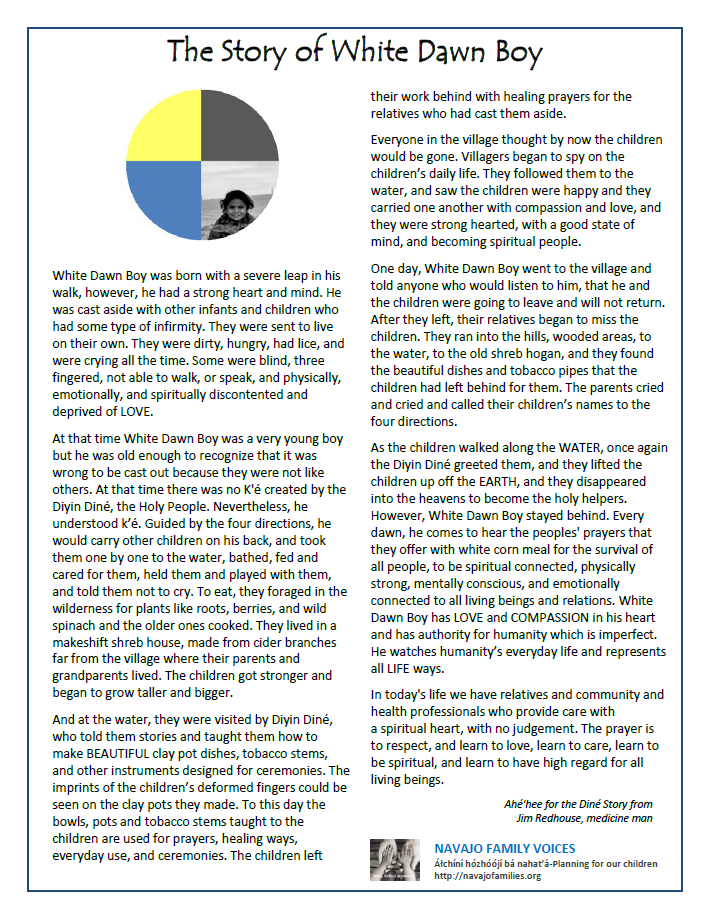
White Dawn Boy
Children transition to adults who will have roles nurtured in childhood—becoming elders to generational children, to the best of their abilities, like White Dawn Boy.
The story of White Dawn Boy is a foundational teaching for our work. It reminds us that every child is a gift, that compassion is our first duty, and that our imperfections create our teamwork.
It is families’ lived experience that enables all of us to manage limited healthcare resources. Our traditional wellness knowledge keepers need us, and our children, to understand the foundation of our knowledge as well as our knowledge keepers, themselves.
Our rural geography especially requires this specialized, community-informed traditional wellness knowledge to be applied in timelessness, in order to address the historical, familial, and regional needs of the Navajo Nation.
T’ááłá’ k’ǫ‘diltłi’dóó biyaadahoo’á’ígíí – Raised Around the Fire
Familial Roles Since Time Immemorial
A family is all who are raised together around the fire, t’ááłá’ k’ǫ‘diltłi’dóó biyaadahoo’á’ígíí, which is the immediate family. This is unlike the western term for “immediate family,” and we at NFV are careful to respect and reclaim the proper term.
Diné familial traditions, maintained for generations, reflect the wisdom passed down through the immediate family since time immemorial.
Roles such as mothers, fathers, siblings, and grandparents involve the entire family, embracing specific parental roles for the maternal and paternal line of uncles, aunts and cousins. The roles carry specific cultural meanings essential to child protection and wellness. When we fulfill these traditional matrilineal roles, we share the specialized knowledge necessary for the health of our children.
This family structure is the foundation of k’é (connections) and ajoobá (kindness), which determine our health and wellness especially for our youth with healthcare needs.
Multi-Jurisdictional Healthcare
The Navajo Nation is more than 27,000 sq. miles, or the size of West Virginia. The vast portion of the reservation is federal trust lands. The Eastern Agency and pockets of the Ft. Defiance and Western Agencies are checkerboard mixtures of private fee lands and allotment lands. The pockets are a historical remnant of the Allotment Era (1887-1934) in which Congress enacted an initiative of President Grover Cleveland to break up tribes as territorial sovereign units. The Allotment Era created massive suffering and loss of land. In 1928, the Meriam Report declared that allotment had been a disaster for Native American communities and poverty, disease, and anger had all skyrocketed on Indian reservations. Health on checkboard areas remains challenging
The major presence is the Navajo Area Indian Health Service (NAIHS) which controls federal trust responsibility-related healthcare. The tribe’s various departments and divisions run stand alone community health programs, primarily under the umbrella of the Navajo Nation Department of Health. Federal law mandates that NAIHS spending for enrolled members may be reimbursed by Medicaid, which at present is run by individual states. New Mexico formally allowed the Navajo Nation to move toward managing its own Medicaid services in 2017 after Congress passed the American Reinvestment and Recovery Act (ARRA), amending federal laws to legally permit the creation of tribal-controlled Indian Managed Care Entities.
Each state maintains distinct public healthcare resource frameworks, which must be integrated with tribal and community-based services. State-run public health programs may integrate with tribal services through inter-governmental agreements (IGAs), and the bulk of Navajo Nation healthcare IGAs are with the State of Arizona with no healthcare IGAs with the State of Utah. The State of New Mexico coordinates its public health services primarily by utilizing local non-profits.
With all states having moved from a fee-based Medicaid to an Insurance-based Medicaid for indigenous patients especially since COVID, the healthcare system on the reservation is uniquely complex, involving the intersection of state, federal, and tribal jurisdictional public healthcare systems with little to no physical state presence.
There are no private healthcare providers, nor is there any state-based public healthcare office on the entire Navajo Nation reservation. Additionally, the NAIHS healthcare system is under-resourced and understaffed. To address this, federal law has long mandated Medicaid-reimbursible referrals to off-reservation healthcare facilities. However, there is no federal mandate for coordinated care.
There remains limited systemic coordination with, or understanding of Diné traditional healing. The medical system continues to treat traditional healing as supplemental and perhaps even contra-indicative to their clinical frameworks and biomedical assumptions. However, historic progress is being made. In October 2024, the Centers for Medicare & Medicaid Services (CMS) approved Section 1115 demonstration waivers for Arizona, New Mexico, California, and Oregon, allowing Medicaid to reimburse for traditional healing services for the first time. These services can include ceremonies, sweat lodges, and herbal medicine, delivered through IHS or Tribal 638 facilities and can be given off-site for the first time.
Supporting families of CYSHCN in a rural tribal setting requires a specific working understanding of cross-jurisdictional health systems and the service gaps. Navigating the Navajo Nation’s complex rural healthcare landscapes presents significant logistical, planning, and knowledge challenges.
Facilitating an integrated understanding of these resources is fundamental to Nahat’á — planning.
For detailed information, Please go to GUIDE FOR HEALTHCARE ON THE NAVAJO NATION.
Áłchíní hózhóójí bá Nahat’á — Planning for Our Kids in a Blessing Manner
Our primary focus is Áłchíní hózhóójí bá Nahat’á — Planning for Our Kids in a Blessing Manner.
Nahat’á — Planning, for Diné families, involves living in connection and right relations with all beings and Mother Earth. It is a core tenet of Diné traditional wellness and healing.
The holistic processes to achieve hózhó (harmony and balance) involve more than a stranger focused on an organ or being given a medicine without enough explanation. Hózhó is wellness that involves acting as a team — ahil na’anish — at every level–the team of organs within the body, the team of people nurturing the fire, and the numerous connections that embrace the environment, the land, Mother Earth and the Cosmos. This is called Diné k’ehgo nitsáhákees.
The traditional planning model that follows the seasons, the path of the sun, and being present and restorative in the great Cosmos of all things, is an essential cultural observance that includes all families, providers, and traditional knowledge keepers in developing collaborative health solutions.
Effective wellness planning for children with extra healthcare needs requires cultural and linguistic competency from service professionals and the direct involvement of the children themselves. Áłchíní hózhóójí bá Nahat’á reinforces a historically-grounded foundation for wellness that has supported tribal families for generations, ensuring that modern healthcare delivery respects the cultural continuity of the Navajo people.
Táá aníltsoh aanihí adanit’eego. It’s up to all of us.
Atkinson Hyperlegible Font is used throughout our website to support accessibility and ensure our resources are welcoming for every family member. This is a specialized typeface developed by the Braille Institute to maximize character distinction and improve readability for readers with low vision, cognitive processing differences, or reading fatigue.
This program is supported by the Health Resources and Services Administration (HRSA) of the U.S. Department of Health and Human Services (DHHS) as part of an annual award of $96,750 beginning in 2018. We are a small program, with other program costs further financed from state agencies and non-governmental sources. The contents of this website are those of the authors and do not necessarily represent the official views or non-endorsement by HRSA, DHHS or the US Government. For more information please visit HRSA.gov.