
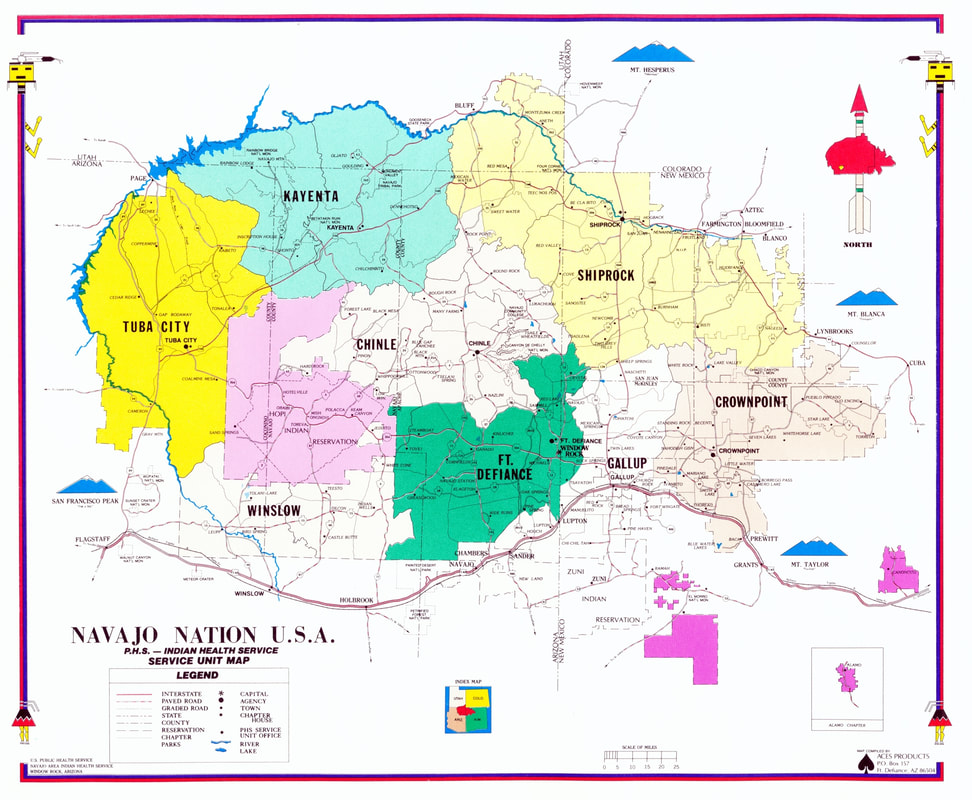
Map of Service Units of Navajo Area Indian Health Service (NAIHS)
This page was last revised on Aug 12, 2026
This page sets forth details of Medical Centers (hospitals) and community health facilities on the Navajo Nation which are either tun directly by the Navajo Area Indian Health Service (NAIHS) or by Title I contract or Title V compact tribal organizations under the Indian Self-Determination and Education Assistance Act (ISDEAA).
We firstly note that healthcare on the reservation is under-resourced and under-staffed. Therefore, a critical part of medical care on the reservation is the ability to refer complex and emergency care off-reservation, which both NAIHS and the ISDEAA facilities may do through the federal law mandated purchased/referred care program.
Also on this page are behavioral and mental health treatment facilities provided directly by the tribe pursuant to a mixture of federal and state funding, the core operational funding being Title 1 contracts under the ISDEAA.
Detailed lists and links to the following facilities are grouped on this page by area served, by facility type, and by provider.
| FACILITIES DETAILED ON THIS PAGE | |
|---|---|
| OPERATOR | NUMBER |
| Medical Centers (Hospitals) | |
| NAIHS | 5 |
| Title I Contract (ISDEAA) Tribal Organizations | 2 |
| Title V Compact (ISDEAA) Tribal Organizations | 3 |
| Community Health Centers (Full-Time) | |
| NAIHS | 4 |
| Title I Contract (ISDEAA) Tribal Organizations | 2 |
| Title V Compact (ISDEAA) Tribal Organizations | 10 |
| Community Health Stations and Clinics (Part-Time or Mobile) | |
| NAIHS | 5 |
| Title I Contract (ISDEAA) Tribal Organizations | 1 |
| Title V Compact (ISDEAA) Tribal Organizations | 2 |
| Behavioral & Mental Health (Outpatient) | |
| NNDOH, Behavioral & Mental Health | 11 |
| Behavioral & Mental Health (Residential and Sober Living) | |
| NNDOH, Behavioral & Mental Health | 3 |
The Navajo Area Indian Health Service (NAIHS) is organized into five (5) federal service units: Chinle and Kayenta in Arizona; and Crownpoint, Gallup and Shiprock in New Mexico.
NAIHS directly operates a medical center in the major population center of each of the 5 service units. Being centers directly run by NAIHS, they adhere to standard IHS operations and procedures with less room for culture-specific core treatment inclusion as core treatments.
The medical centers run by NAIHS have a total 252 beds.
| MEDICAL CENTERS RUN BY NAIHS | ||
| Chinle Service Unit | ||
| Chinle Comprehensive Health Care Facility (60 beds) | ||
| Crownpoint Service Unit | ||
| Crownpoint Health Care Facility (20 beds) | ||
| Kayenta Service Unit | ||
| Kayenta Alternative Rural Hospital (13 short term nursing beds) | ||
| Gallup Service Unit | ||
| Gallup Indian Medical Center (99 beds) | ||
| Shiprock Service Unit | ||
| Northern Navajo Medical Center (60 beds) | ||
Staffing Challenges. Government oversight reports confirm severe NAIHS staffing challenges. While the nationwide average provider vacancy rate for the IHS sits around 25%, remote areas like the Navajo Nation frequently hit or exceed 30% vacancy rates for critical personnel, including physicians, general surgeons, and nurses. This leaves clinical teams heavily reliant on temporary, contract-based locum tenens providers to keep operating rooms open or off-reservation referrals through the PRC Program.
Facility Differences in Clinical Capabilities. Among the medical centers is a difference in clinical capabilities. While major hubs like Gallup and Shiprock maintain active general surgery departments, smaller facilities like Kayenta operate strictly as outpatient and emergency stabilization centers. Furthermore, across all NAIHS facilities, the 30% vacancy rate regularly force localized emergency diversions. When critical personnel like general surgeons or anesthesiologists are missing, even a standard emergency appendectomy cannot be performed locally, forcing patients into hours-long transfers to off-reservation hospitals.
Same-day Appointment/Walk-in Clinic and a Rationed Lottery. Appointments at the medical centers are driven directly by severe underfunding and provider shortages. The operational details of this practice, the reasons behind the long wait times, and how procedures differ across the network highlight the structural challenges patients face. At some facilities, patients may be told to arrive at 7:30 AM (and many actually arrive much earlier, lining up outside in the dark. Understaffed centers only have a limited number of open slots each day. Staff hand out tickets or assign slots to the people waiting in line. If 40 people line up but the clinic only has enough doctors to see 15 walk-ins that day, numbers 16 through 40 are turned away. They are told to go home and try lining up again at 7:30 AM the next morning. If a patient does get a slot, they often face a multi-hour wait in the waiting room before a provider actually sees them.
Because smaller community clinics (like Tohatchi or local chapter houses) frequently face temporary closures due to staffing shortages or utility outages, hundreds of rural patients need to drive to major hubs like Shiprock or Gallup. This completely overwhelms those larger central waiting rooms.
Several Medical Centers and Health Centers, primarily in the Western Agency and along the Arizona State Route 264 Southern corridor, are now operated by Navajo Nation-designated tribal organizations pursuant to the Indian Self-Determination and Education Assistance Act (ISDEAA) or P.L. 93-638, enacted by Congress in 1975.
There are 5 ISDEAA medical centers with 168 total beds.
| ISDEAA “638” MEDICAL CENTERS | ||
| Title I Medical Centers | ||
| East-Central along Arizona State Route 264 Corridor | ||
| Sage Memorial Hospital, Inc. Ganado, AZ (Navajo Health Foundation) (25 beds). The mission at the Navajo Health Foundation – Sage Memorial Hospital is to provide quality healthcare for the Diné people with respect, unity, beauty, and harmony in honor of K‘é and the sacredness of life. | ||
| Tséhootsooí Medical Center Fort Defiance, AZ (Ft. Defiance Indian Hospital Board, Inc.) (56 beds) | ||
| Title V Medical Centers | ||
| Southeastern Utah | ||
| Utah Navajo Health System, Inc. (Utah Navajo Health System) Montezuma Creek, UT (outpatient only) | ||
| Southwestern District 5 | ||
| Dilkon Medical Center Dilkon, AZ (Winslow Indian Health Care Corp.) (5 inpatient beds) | ||
| Western Agency | ||
| Tuba City Regional Health Care Tuba City, AZ (Tuba City Regional Health Care Corp. (TCRHCC)) (73 beds) | ||
The ISDEAA provides the authority for a tribe to operate its own medical and health programs, either directly or through designated tribal organizations. The Navajo Nation uses both approaches, directly running its behavioral health (non-medical) programs, and designating tribal organizations to run medical centers. There are two kinds of ISDEAA agreements to run a medical facility.
Title I “638 contracts.” In Title I “638 contracts,” tribals or tribal organization step into the shoes of the federal government, their duties often limited to what the federal government interprets as its trust responsibility in healthcare, providing services “that the IHS otherwise would have provided.” Such contracts are monitored closely by the NAIHS and come with rigid program design and spending constraints and are intended to be short-term.
Title V Sovereign Partner. Once the tribal contractor shows financial capacity, usually after three years free of audit findings, they may leave behind their contractor status and become sovereign partners to the federal government through a Title IV compact. While still overseen by the NAIHS, they have high flexibility to redesign organizational structures, streamline hiring, tailor clinical services, bring in traditional healers, allocate and invest block grants, and adapt policies to local community needs. The central advantage of Title V is the authority to manage and tailor health programs to best fit the needs of your community, and flexibility in reallocating and investing 638 funds.
ISDEAA facilities can pivot much faster than facilities run directly by the NAIHS when there are challenges e.g. federal hiring freezes, or regional vacancies. While ISDEAA facilities face many of the same systemic resource constraints, rural issues and high patient demand, they are able to handle operations and clinical scheduling with greater organizational flexibility. They establish their own human resources policies, salary scales, and administrative workflows tailored specifically to the cultural and geographic realities of the Navajo Nation rather than standardized procedures used by IHS across all reservations.
If a specialist is unavailable, ISDEAA facilities also rely heavily on emergency patient transfers or Purchased/Referred Care (PRC) pathways off-reservation. However, their relative autonomy frequently allows them to staff up more effectively or build specialized service lines (such as expanded youth residential care, local dialysis units, or integrated traditional medicine programs) faster than a direct NAIHS facility could under standard federal controls. They have more administrative freedom to experiment with alternative scheduling templates, expanded phone-triage systems, or mobile health clinics deployed directly to chapter houses to intercept crowds before they bottleneck the main hospital lobby.
Full-time health centers and part-time or mobile health stations and clinics are run either directly by NAIHS or by Title I contract or Title V compact ISDEAA tribal organizations. These are intended to be rural community health hubs and are located outside the population centers of the reservation. They serve the Navajo Nation’s widely dispersed population seeking routine primary care, testing, dental care, optometry, and mental health counseling among other non-complex and non-specialty care services without having to travel to reservation population centers where the Medical Centers are located.
Part-time health stations and clinics that are run by tribal organizations are sometimes named “health centers” which may be confusing.
These community-based health facilities do not have overnight inpatient wards, full surgical suites, or 24/7 emergency rooms. They do feature staffed ambulatory care, basic triage, and urgent outpatient treatment rooms.
With high regional vacancies, capacity to address care depends on staffing. A local provider or nurse practitioner can typically clean, numb, and stitch up straightforward, uncomplicated cuts, manage minor fractures, handle routine acute illnesses, and dispense basic medications from their on-site pharmacies. If a cut is deep, involves tendon/nerve damage, requires plastic surgery-level facial closure, or happens after outpatient operating hours (when the health center is locked up for the evening), they will not be able to treat it locally. Any major trauma, severe medical emergency occurring after hours, or specialized surgical need forces a transfer to the nearest major NAIHS or ISDEAA Medical Center or referred off-reservation.
All full-time and part-time community health centers are directly run by NAIHS unless otherwise stated.
| FULL-TIME OUTPATIENT HEALTH CENTERS | |
| Remote Eastern (including Huerfano, Nageezi and Counselor) | |
| Dzilth-Na-O-Dith-Hle Health Center, Dzilth-Na-O-Dith-Hle, NM | |
| Services: | Outpatient primary care, family medicine, routine dental care, pharmacy, laboratory services, X-ray, and preventative public health programs |
| Chuska Mountains and Diné College | |
| Tsaile Health Center, Tsaile, AZ | |
| Services: | Primary outpatient medical care, geriatrics, prenatal care, dental, optometry, pharmacy, lab, radiology/X-ray, mental health, social services, and diabetes/nutrition education |
| Central-Eastern | |
| Tohatchi Health Care Center, Tohatchi, NM | |
| Services: | Ambulatory care, routine physical exams, immunizations, chronic disease management (diabetes/hypertension), pharmacy, basic lab work, X-ray, and behavioral health services. |
| Four Corners border junction and Red Mesa | |
| Four Corners Regional Health Center, Teec Nos Pos, AZ | |
| Services: | Primary care, a dedicated urgent care clinic for higher-acuity walk-ins, full dental suites, physical rehabilitation/physical therapy, optometry, mental health, social services, public health nursing, on-site pharmacy, lab, and plain-film X-ray. |
| Central interior | |
| Pinon Health Center, Piñon, AZ | |
| Services: | Primary care, women’s health/nurse-midwifery, podiatry, physical and speech therapy, optometry, dental care, pharmacy, laboratory, X-ray, mental health/substance abuse counseling, and public health nursing. |
| New Lands (Nahat’á Dziil Commission Governance area) | |
| Nahat’á Dziil Health Center, Sanders, AZ (ISDEAA Title I community hub run by the Fort Defiance Indian Hospital Board, Inc. (FDHIB)) | |
| Services: | Primary care and family medicine, dental care, optometry, podiatry, physical therapy and rehabilitation, behavioral health, chronic disease management (diabetes and hypertension), on-site pharmacy, laboratory, and radiography (X-ray). |
| Southwest and border towns | |
| Winslow Indian Health Care Center Winslow, AZ (off-reservation) (ISDEAA Title I community hub run by Winslow Indian Health Care Corp.) | |
| Services: | Ambulatory care, primary care, urgent care, dental, and specialty clinics |
| Western Agency | |
| Navajo Mountain Community Health Center, Navajo Mountain, UT / Tonalea, AZ Monument Valley Community Health Center, Monument Valley, UT Montezuma Creek Community Health Center, Montezuma Creek, UT off-reservation: Blanding Family Practice, Blanding, UT; San Juan Dental, Monticello, UT (all ISDEAA Title V facilities run by Utah Navajo Health System, Inc.) | |
| Services: | Ambulatory care, family medicine, lab, preventative care, on-site pharmacy, CHR coordination |
| Specialty Care Center, Tuba City, AZ (ISDEAA Title V facility of TRHHC) | |
| Services: | Local Oncology specialty services, including the House of Hope at 039 N. Main Street, Tuba City, a facility where patients and caregivers can access support and navigation services and is home to the Cancer Support Community (CSC) program, which offers culturally sensitive support and counseling. Specialty Care Center is the first full-time cancer care program on any American Indian reservation |
| LeChee Health Center, near Page, AZ (ISDEAA Title V satellite facility of TRHHC) | |
| Services: | Family medicine, pediatrics, orthopedics, dermatology, ENT allergist, anticoagulant therapy, diabetes education, mental health, physical therapy, diabetes prevention/wellness center. |
| Remote Western | |
| Inscription House Health Center, Tonalea, AZ | |
| Services: | General ambulatory family medicine, internal medicine, pediatrics, prenatal care, dental care, physical therapy, optometry, mental health counseling, health education, laboratory, pharmacy, and X-ray. Note: this facility may have scaled back its hours. |
| Off-reservation (Flagstaff) | |
| Sacred Peaks Health Center, Flagstaff, AZ (ISDEAA Title V satellite facility of TRHHC) | |
| Services: | Non-emergency primary health care. Note: this facility has temporarily suspended operations as of 8/1/2026. |
| PART-TIME HEALTH STATIONS AND CLINICS | |
| Shiprock Service Unit | |
| Toadlena Health Station, Toadlena, NM | |
| Hours: | No specific hours |
| Contact: | Phone: (505) 368-6001 | Address: Navajo Route 19, Toadlena, NM, 87324 |
| Services: | Family primary care, blood draws, medication management, women’s screening, behavioral health support. |
| Newcomb Health Station, Newcomb, NM | |
| Hours: | No specific hours |
| Contact: | Not found |
| Services: | Outpatient clinical medicine, immunizations, X-ray |
| Chinle Service Unit | |
| Rock Point Clinic, Rock Point, AZ | |
| Hours: | Tues, 9:00 AM – 3:00 PM |
| Contact: | Phone: (928) 659-4282 | Address: Hwy 191, Rock Point, AZ 86545 |
| Services: | Outpatient primary care, nursing check-ups, immunizations, chronic condition tracking, pharmacy pickup. |
| Kayenta Service Unit | |
| Dennehotso Health Station, Dennehotso, AZ | |
| Hours: | Mon, Tues, Thu |
| Contact: | Phone: (928) 672-3000 | Address: Hwy 160 (MP 419), Bldg DE-2000 |
| Services: | Outpatient ambulatory services that includes internal and family medicine, nurse only visits, laboratory, pharmacy and health education. |
| Shonto Health Station, Shonto, AZ | |
| Hours: | No specific hours |
| Contact: | Not found |
| Services: | Nurse-led triage, physical exams, urgent stabilization, pharmacy pickup, wellness education. |
| Southwestern edge | |
| Leupp Field Clinic, Leupp, AZ (ISDEAA Title I facility run by Winslow Indian Health Care Center) | |
| Hours: | Mon, Wed, Thurs, & Fri: 9:00 AM to 3:30 PM. Tues: Late afternoon only, from 1:00 PM to 3:00 PM. |
| Contact: | Phone: (928) 686-6550 | Address: Highway 15, Campus of Leupp School, Leupp, AZ 86035 |
| Services: | Outpatient ambulatory, primary family medicine, walk-in care, dental services, behavioral health counseling, and 24/7 care call line. |
| Western Agency | |
| Cameron Healthcare and Dental, (ISDEAA Title V facility of TRHHC) | |
| Hours: | Tuesday and Wednesday mornings: 8am-12pm; Pediatric Dental Tuesdays 8am-5pm |
| Services: | Non-urgent primary care and dental |
| Community Health Center, Mobile Health Program, (ISDEAA Title V facility of TRHHC) | |
| Services: | Coordinates with community agencies, such as schools, chapter houses, and senior centers at Cameron, Bodaway/Gap, LeChee, Kaibeto, Tonalea, Coalmine Canyon, Coppermine and surrounding communities |
| Echo Cliffs Health Center, Coppermine, AZ (ISDEAA Title V facility of TRHHC) | |
| Hours: | Opening in Fall 2026 |
| Services: | Primary care, dental, eye care, EMS, and other programs |
The tribe directly runs its own community health programs with core ISDEAA Title I funding braided with other funds. Tribal health programs have received annual operational funds through an ISDEAA Title I contract with the IHS since 1996, which means the tribe has been a federal healthcare contractor for 30 years.
In November 2024, the Navajo Nation Council approved a ten-year ISDEAA master 638 contract through Naabik’ iyati’ Committee Resolution NABID-68-24 specifically for the Navajo Nation Department of Health (NNDOH)’s subordinate programs to be funded and overseen by the Navajo Area Indian Health Service (NAIHS). This master contract, beginning January 1, 2025, federally funds and allows the NNDOH to administer programs the federal government considers within its general welfare trust responsibility, like the Division of Behavioral and Mental Health Services (DBMHS), Division of Public Health Services, and the Community Health Representative (CHR) Program.
The DBMHS relies on a complex, multi-layered funding structure that combines Title I contracts, federal contracts, grants, and state agreements including funds from the State of New Mexico, SAMHSA awards, and through state IGAs (primarily with Arizona) to expand its capacity and services . This layered approach allows the DBMHS to operate core services and also pursue specific initiatives like crisis response and opioid treatment. E.g. in 2026, DBMHS has a Title I operating budget of $18.17 million, with $1,925,000 from SAMHSA for opiod response, and $23,879 via an IHS grant for the CHR Program.
Traditional Healing. Traditional healing is an active and integrated component of DBMHS care, particularly through its culturally grounded programs.
Below are tribally-run ISDEAA walk-in and residential facilities.
| RESIDENTIAL SUBSTANCE ABUSE & SOBER LIVING FACILITIES | |
| Phoenix, AZ | |
| Residential Treatment – Yideeską́ądi Hózhǫ́ǫ́jí Center (YHC) (92 beds) | |
| Details: | The first Navajo Nation-owned residential substance use treatment facility outside the Nation, combining evidence-based care with traditional Diné healing practices and White Bison developed programming. Services include cultural/spiritual support, talking circles, and smudging ceremonies. |
| Philosophy: | “Navajo healing Navajo.” This is a core part of its identity as a Navajo Nation-owned facility. |
| Transitional Apartments Tied to YHC | |
| Details: | A $4.9 million apartment complex for those who have completed residential treatment acquired in early 2026. Provides post-treatment housing with wrap-around services, operated alongside Yideeską́ądi Hózhǫ́ǫ́jí Center (YHC) |
| Chinle, AZ | |
| Sober Living/Residential – Sober Living Center | |
| Services: | A structured, open-ended sober living environment for Native American adults and their families. Provides a healthy setting to develop skills for a drug/alcohol-free life, including traditional and spiritual counseling, traditional education, and family activities. |
| Focus: | The program explicitly lists “Traditional and Spiritual Counseling Services” and “Traditional Education” among its supportive services. |
| Shiprock, NM | |
| Residential Treatment – Navajo Regional Behavioral Health Center | |
| Status: | Under development. In May 2026, a 36-month, $818,270 contract was approved to provide professional guidance to reopen and develop residential behavioral health services for adults and adolescents at this facility. |
The tribe administers ten outpatient treatment facilities across Arizona and two outpatient centers in New Mexico. The facilities treat low intensity ASAM (American Society of Addiction Medicine) conditions–ASAM 0.5 (early intervention) and ASAM 1 (general outpatient), meaning only patients who not require intensive, round-the-clock psychiatric or medical monitoring.
The Crownpoint and Gallup centers expressly integrate traditional practitioners and cultural practices into their outpatient services.
| OUTPATIENT BEHAVIORAL/MENTAL HEALTH FACILITIES | |
| Chinle, AZ | |
| Chinle Outpatient Treatment Center | |
| Details: | Part of the Chinle Outpatient and Sober Living Center campus, which also includes a residential/sober living component. |
| Services: | Prevention & early intervention, outpatient treatment, traditional services, individual therapy, group/family therapy and aftercare services. |
| Dilkon, AZ | |
| Dilkon Outpatient Treatment Center | |
| Services: | Prevention & early intervention, outpatient treatment, faith-based services, traditional services, individual therapy, group/family therapy and aftercare services. |
| Ft. Defiance, AZ | |
| Fort Defiance Outpatient Treatment Center | |
| Services: | Prevention & early intervention, outpatient treatment, faith-based services, traditional services, individual therapy, group/family therapy, aftercare services, crisis counseling/intervention, Duluth Men’s Group (Domestic Violence), Question, Persuade and Refer (QPR), postvention, and celebrate recovery. |
| Kaibeto, AZ | |
| Kaibeto Outpatient Treatment Center | |
| Services: | Prevention & early intervention, outpatient treatment, faith-based services, traditional services, individual therapy, group/family therapy, aftercare services, and daily, on-site AA classes. |
| Kayenta, AZ | |
| Kayenta Outpatient Treatment Center | |
| Services: | Prevention & early intervention, outpatient treatment, faith-based services, traditional services, individual therapy, group/family therapy and aftercare services. |
| Sanders, AZ | |
| Newlands Outpatient Treatment Center | |
| Services: | Prevention & early intervention, outpatient treatment, faith-based services, traditional services, individual therapy, group/family therapy, aftercare services, crisis counseling/intervention. |
| Status: | Facility is temporarily closed as of June 30, 2026, See PSA. |
| Red Mesa, AZ | |
| Red Mesa Outpatient Treatment Center | |
| Services: | Prevention & early intervention, intake/referral |
| Tuba City, AZ | |
| Tuba City Outpatient Treatment Center | |
| Services: | Prevention & early intervention, outpatient treatment, faith-based services, traditional services, individual therapy, group/family therapy and aftercare services. |
| Crownpoint, NM | |
| Crownpoint Outpatient Treatment Center | |
| Services: | Substance use assessments, Fatherhood and Motherhood curriculum, anger management, prevention & early intervention, outpatient treatment, faith-based services, traditional services, individual therapy, group/family therapy, aftercare services, crisis counseling/intervention. |
| Gallup, NM | |
| Gallup Outpatient Treatment Center | |
| Services: | Prevention & early intervention, outpatient treatment, traditional services, individual therapy, group/family therapy, aftercare services, crisis counseling/intervention |
(505) 226-3073
POB 3085, Kirtland, NM 87417
and POB 744, Farmington, NM 87499