

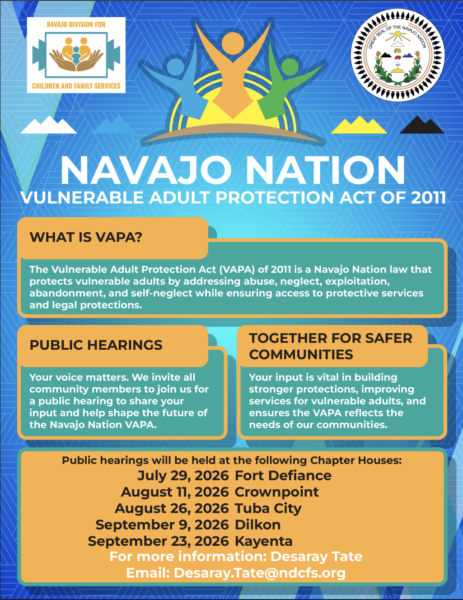
(Note: As of Sept 16, 2026 Public Hearings are presently underway to amend this law)
The Vulnerable Adult Protection Act of 2011 (VAPA) was passed via Navajo Nation Council Resolution CJA-02-12 on January 24, 2012 after three attempts. The law was drafted by the Native American Disability Law Center (NADLC).
The VAPA is unavailable for public access on any official governmental website. Families and advocates have had no systematic, accessible way to know this law exists or to understand its provisions. This page is a vital act of making the law known to families.
The version presented here is an informal conversion to searchable and indexed HTML created with the assistance of the Diné Nihi Kéyah Project from a PDF of the original resolution. It is not an official codification or a substitute for the official resolution, and is for educational and informational purposes only. While every effort has been made to ensure accuracy, users should always refer to the official resolution (CJA-02-12) for any legal matters.
a. Western Punitive Framework
The VAPA embeds a Western punitive framework within the civil portion of the Navajo Nation Code, with only brief non-descriptive mentions of peacemaking and hataałii.
There is no mention at all of matriarchal disciplinarians who, in unified familial systems, exert authority to ensure relational obligations are met in integrated interdependence and in our ancestrally instructed freedoms of k’é and hózhó.
Even the category of “vulnerable” persons is a Western legal construct, creating a distinction between the “vulnerable” and the “non-vulnerable.” This is foreign to Diné understanding, in which everyone is vulnerable at different times—infants, elders, the sick, the grieving, those in transition. By categorizing people into binary “vulnerable” (versus “non-vulnerable”), the law overwrites the natural, cyclical understanding of life where vulnerability is a shared human condition.
b. Invisibility of Traditional Measures
When there is abuse, neglect, or harm within the family, the family with the intervention of the wider circle of relatives and with the assistance and education of peacemakers and hataałii ought to be the first restorative measure. However, this law leans heavily on the courts and the powers of a court to punish and oversee while rendering the traditional measures invisible.
This law mentions peacemaking as an afterthought, under oversight of a court, and only when “safe,” as if the Diné family and community cannot be entrusted. It is as if this law were written by those to whom Diné Bi Beehaz’áanii Bitse Siléí is entirely unknown. The traditional methods of calling the family back to its obligations are not mentioned, the ancestral trail abandoned, perhaps, because the drafters do not know it.
There is no doubt there are harms being done among our people who have lived generations in poverty, unconnected from paved roads, power and water, and in under-resourced and unemployed communities where families have to move far from the communities to get some help. Families especially in disconnected rural areas fall into trauma, despair and unbalance. In such areas, children age into adulthood with no options. Tribal agencies have begun to believe that removing children from such isolated families and placing them with any family member in a more urban area is the only option for future generations. They do this rather than work together to solidify the families, because realistically the agencies lack the funds, nor do they have any mandate to pursue non-court methods that rely on ceremony, peacemaking, reconstitution of family, and hataałii. The PL93-638 basis of tribal governmental functions also means no “scope of work” within the agencies to use Diné bi beenahaz’áanii.
Restorative methods known to us rely on consequences and education by those who know the living framework of mutual existence. Western law’s answer is to create mechanisms to punish a wrongdoer without also recognizing the consequences that already exist. For our families and communities, when harm occurs, the consequences are immediate and relational—k’é and hózhó are inseparable from the core of Diné identity and belonging. These consequences, and especially the disruption to familial joys when our distinct parts are out of balance, are more powerful than any court punishment, yet none of these are addressed in the VAPA.
c. Court System in Crisis
To look to the present tribal court system as a mechanism for rescue or justice is to ignore its current reality. Plagued by massive case backlogs since 2016 numbering in the tens of thousands, severe administrative strain, and chronic operational bottlenecks, the Navajo Nation courts are deeply overwhelmed and struggling to manage their existing dockets. Relying on this overburdened, container-based institution when there are traditional mechanisms is a profound disservice to our families. See State of Crisis in the Navajo Nation Court System, Katherine LeBlanc Esq., Aug. 3, 2023 (LeBlanc’s letter to tribal leadership is published here as a matter of public concern).
d. Crisis of Departmental Vacancies
The Navajo Nation government faces a severe vacancy crisis, with more than 1,500 critical job openings out of an estimated 7,000 budgeted positions (a 20% vacancy rate). The Division of Social Services filled only 350 out of 600 total roles in April 2023. Such agencies with high vacancies, limited also by PL93-638 scopes of work, need community integration even to simply function.
e. No Familial Role for the “Vulnerable”
Bitsé siléí is not a containment but a trail of all of us. In striving to “protect,” this law lacks any self-chosen remediation which relies on full participation of the “vulnerable” in the sharing of familial joys.
f. No Restorative Roles
Finally, § 1905(D) of this law treats the family as a reporting apparatus. A spouse, parent, or child who fails to report suspected abuse to professional authorities faces a civil penalty of up to $500. To be aligned with Diné bi beenahaz’áanii, perhaps the “reporting” should be to a peacemaker or hataałii with the goal of full participation, familial discipline, and mutual feeling, before resorting to a tribal court system already so underfunded and overburdened that families feel, themselves, consigned to neglectful despair by a system unable to serve them.
The law exempts hataałii from the duty to report, but gives them no corresponding authority to intervene, to call the family back to its obligations, or to guide restoration. It is a strange exemption: freedom from a burden, but no share in the path forward.
Beginning July 2026, efforts to amend the VAPA are underway that appear to be focused on allowing vulnerable persons to directly sue for reasonable accommodations and monetary damages in Navajo Nation court.
This appears to be the solution of the primary drafter, the NADLC, in collaboration with Navajo Nation Department for Child Well-Being, to address long-standing enforcement gaps, funding shortages, and the practical isolation of the law due to chronic underfunding. However the solution ignores that there is a crisis in the courts, and high vacancies in Social Services.
Despite the public hearings, neither the current VAPA nor the intended amendment text are available on official sites.
§ 1901. Short title This Act shall be known as the “Doris Act.”
§ 1902. Purpose In harmony with traditional and/or common law, it is the policy of the Navajo Nation to respect, revere and protect all individuals, their communities, and their unique qualities. Consistent with this policy, the Navajo Nation, through its government-sponsored agents, accepts the responsibility to assist in providing for the physical and mental well-being of all individuals which includes the protection of vulnerable adults and the prevention of their abuse, neglect, and exploitation.
Based upon these premises it is in the Navajo Nation’s best interest and welfare to enact laws to protect vulnerable adults. This act shall be liberally interpreted in order to achieve this purpose.
§ 1903. Definitions The following definitions are applicable to this subchapter:
A. “Abuse” means one of the following:
An attempt to cause bodily harm to another person through the use of force, or the creation in another of reasonable fear of imminent bodily harm;
Application of force to the person of another resulting in bodily harm or an offensive touching;
Threatening words or conduct which places another in fear of physical or other harm on any person or on property;
Compelling an unwilling person, through force or threat of force, to engage in or abstain from conduct which the person has a right to abstain from or engage in;
Unreasonable confinement, intimidation or acts of cruelty which result in physical harm or pain or mental anguish of a vulnerable adult by any person, particularly anyone such as a spouse, a child, other family members, caregiver(s) or other persons recognized by Navajo statutory or common law as having a special relationship with the vulnerable adult;
Sexual abuse which is any physical contact with a vulnerable adult for emotional or physical gratification of the person making the contact and to which the vulnerable adult does not give consent or for which the consent is obtained by intimidation or fraud;
Emotional abuse involving the infliction of mental anguish, threats, or humiliation;
Intimidation by willfully placing another in fear of harm by coercion, extortion or duress;
Using funds, property or other resources for personal gain, or failure to use the funds, property or other resources for the benefit of the vulnerable adult; including leaving child(ren) unattended in the care of a vulnerable adult, who may resort to using their limited resources to meet the needs of the child(ren). Consent cannot be obtained by threat, retaliation, humiliation, intimidation, coercion, or fraud;
Desertion of a vulnerable adult by the person’s family or caregiver(s), which includes refusing or neglecting to provide for a person when there is a duty to do so, as defined by Navajo law;
Breach by a family member or caregiver of his or her fiduciary duties toward a vulnerable adult.
B. “Caregiver” means:
A person who is required by Navajo statutory or common law to provide care, services or resources; or
A person who has undertaken to provide care, services or resources; or
An institution or agency, or employee or agent of an institution or agency, which provides or is required by Navajo statutory or common law, state or federal law, or tribal-state agreement to provide services or resources.
C. “Court” means the Navajo Nation courts.
D. “Division” means the Navajo Nation Division of Social Services or an organization contracted to provide similar adult protective service.
E. “Elder” is a person who is at least fifty-five (55) years of age or older.
F. “Family” includes spouse, children, grandchildren, grandparents, in-laws, siblings, aunts, uncles, nieces, nephews, first, second, and third cousins, or as defined by Navajo custom.
G. “Good Faith” means an honest belief or purpose and the lack of intent to hurt, injure, exploit or defraud.
H. “Incapacity” means the current functional inability of a person to sufficiently understand, make and communicate informed decisions as a result of mental illness, mental deficiency, physical illness, disability, or chronic use of drugs (legal or illegal) or alcohol. Incapacity may vary in degree and duration or as determined by Navajo Nation Courts.
I. “Least restrictive alternative” is that environment which is most like the vulnerable adult’s home setting and which is capable of supporting the person’s physical, mental and emotional health.
J. “Law Enforcement” is the Navajo Nation Police Department.
K. “Neglect” means when a caregiver or family member fails to provide basic needs, supervision, care, services, or resources necessary to maintain the physical and mental health of a vulnerable adult as required by law, including but not limited to, preventing or interfering with delivery of necessary care, services and resources.
L. “Perpetrator” means the individual(s), or institution or agency accused of or found to be abusing, neglecting or retaliating against a vulnerable adult.
M. “Protective Services” means services provided by the Division to a vulnerable adult, either with the consent of the vulnerable adult, the vulnerable adult’s guardian or by court order if that adult has been abused or neglected. Protective Services may include but are not limited to social services, safe environment, mental and physical health examinations, home and day care services, legal assistance, case management, and any other services consistent with this Act.
N. “Retaliation” includes threatening, harming, harassing or otherwise interfering with an individual reporting abuse and/or neglect, including threats or injury to an individual’s family, property, and employment status of the reporter or the reporter’s family in any way.
O. “Vulnerable Adult” means a person who is emancipated or is eighteen (18) years of age or older, who lacks the ability to make responsible decisions for himself/herself because of mental illness, cognitive impairment, physical disability or illness, use of prescription medication, or chronic use of alcohol or drugs (legal or illegal). A person who has a physical, mental, or emotional disabling condition, regardless of residence or type of services provided, that:
Impairs the individual’s ability to provide adequately for the individual’s own care without assistance, including the provision of food, shelter, clothing, health care or supervision;
Because of the condition and the need for assistance, the individual is unable to protect himself/herself from abuse and/or neglect; or
Is found to be in a situation or condition in which there is imminent risk of serious harm, or threat of danger or harm to his/her emotional or physical health.
A vulnerable adult also includes, but is not limited to, individuals who regardless of decision-making capacity are a resident of a caregiver or a person who receives services from a caregiver.
§ 1904. Adult Protective Services
A. The Navajo Nation through the Division shall provide necessary protective services to a vulnerable adult by using the least restrictive available alternatives.
B. The Division shall utilize its policies and procedures to carry out the duties and responsibilities outlined in this subchapter.
§ 1905. Duty to Report Abuse and/or Neglect; Immunity
A. Any person who has reason to believe or knows that a vulnerable adult has been abused and/or neglected shall immediately report the abuse and/or neglect to Adult Protection Services or Law Enforcement.
B. A person who in good faith makes a report pursuant to this subchapter is immune from civil or criminal liability.
C. Any person who fails to report or knowingly makes a false report of abuse and/or neglect of a vulnerable adult is subject to a civil penalty of up to five hundred dollars ($500.00). The person may also be subject to any criminal penalties as allowed by law. Nothing in this section shall preclude a person from filing a civil suit.
D. No privileged relationship except for the attorney-client or spiritual/traditional practitioner may be raised as a defense for failing to report suspected abuse and/or neglect.
§ 1906. Receiving Reports; Report Content; Retention of Report
A. Protective Services or Law Enforcement shall receive and create a written record of all reports of abuse and/or neglect.
B. A report may be oral or in writing and to the extent possible shall contain:
The name, address and location of home, telephone number, census and social security number of the vulnerable adult;
Name, address, location, telephone number of the alleged perpetrator;
The condition of the vulnerable adult;
The name, address, location, telephone number of any witness(es);
The name, address, location, telephone number of the vulnerable adult‘s caregiver(s);
A description of the alleged acts and any other pertinent information. C. Protective Services and Law Enforcement shall investigate all reports regardless of whether all information required by § 1906 (B), herein, is provided. D. Such reports shall be confidential to the extent allowed by law.
§ 1907. Preliminary Protective Services
A. Protective Services shall assess and determine the need for immediate intervention pursuant to its priority system and take necessary steps to provide protective services in the least restrictive environment.
B. If the initial report involves an adult who requires twenty-four (24) hour care and/or allegations of imminent harm, a social worker and/or Law Enforcement officer shall intervene immediately.
C. If no immediate intervention is required, a protective services investigation shall be initiated no later than seventy-two (72) hours after receipt of the initial report.
D. A written report shall be prepared within ten (10) days of receipt of the initial report. During the investigation the home environment, the risk to the individual and all other pertinent facts or matters shall be evaluated and assessed.
E. If Protective Services finds that Court intervention is warranted, it shall refer the matter to the Office of the Prosecutor.
F. Protective Services may cooperate with states and community agencies as necessary to achieve the purpose of this Subchapter.
§ 1908. Investigations by Law Enforcement
A. Law Enforcement shall:
Investigate all matters reported or referred by any individual or agency regarding abuse and/or neglect of a vulnerable adult;
Be available twenty-four (24) hours a day seven (7) days a week to respond to and investigate reports of alleged abuse and/or neglect;
Immediately consult with Protective Services regarding the report if an emergency placement is necessary;
Conduct investigations of all reports of abuse and/or neglect pursuant to established protocols, including identified timelines, and with appropriate disability-related accommodation for the individual’s needs.
B. Upon the report of alleged abuse and/or neglect, Law Enforcement will immediately notify the Division of the report.
C. When a report of abuse and/or neglect is reported and a request is made for an immediate welfare check of the vulnerable adult, a Law Enforcement officer will:
Respond to the location where the vulnerable adult is located;
Make direct contact with the vulnerable adult to assess the individual’s safety, including entering the residence and assessing the home environment;
Upon assessing the situation report to the Division for immediate intervention if the vulnerable adult’s safety is at risk. D. When conflicts of jurisdictional issues occur, Law Enforcement will notify the local agency jurisdiction by telephone and follow-up with a copy of the report. E. The identity of any person making a report shall not be disclosed, except as otherwise provided by applicable Navajo Nation, Federal and/or State Laws. F. Determination of priority for action shall be a joint decision of the responsible agencies and/or investigators through the exercise of their professional judgment.
Response is determined by the apparent potential risk of harm to the vulnerable adult. Priority assessments will be determined on a case-by-case basis.
The Law Enforcement officer can request the assistance of a Protective Service Worker.
Law enforcement shall assist as appropriate and as availability allows in situations where the vulnerable adult is in no immediate danger or where his/her safety is assured. G. Law Enforcement/Criminal Investigator shall inform the Prosecutor of on-going investigations involving alleged criminal offenses relative to abuse and/or neglect; and the U.S. Attorney’s Office, when appropriate. All necessary police reports/investigative reports containing factual information shall be referred to the Prosecutors and the U.S. Attorney’s Office for prosecution determination.
§ 1909. Filing a Petition
A. The Navajo Nation may assist the vulnerable adult or any other person or party to petition the Courts for an Adult Protection Order. This Petition will contain allegations that abuse or neglect of a vulnerable adult has occurred.
B. A petition shall be filed by the Prosecutor on behalf of the Navajo Nation.
C. Any person who has knowledge of the facts alleged or is informed of them and believes that they are true, upon information and belief, may cause a petition to be initiated by the Prosecutor alleging that the vulnerable adult has been abused or neglected under this Act.
D. A vulnerable adult may file a petition Pro Se consistent with § 1913.
§ 1910. Legal Intervention A vulnerable adult seeking protection shall not be required to reveal his/her address or place of residence except to the judge, in chambers if required, for the purposes of determining jurisdiction and venue.
The Office of the Prosecutor will review all referrals and determine the need for intervention. The Prosecutor shall determine the type and level of intervention on each case within ten (10) working days, unless further information is needed. The Office of Prosecutor has sole discretion in the decision to initiate legal proceedings in the Courts, on behalf of the Navajo Nation.
The Office of the Prosecutor shall coordinate with Law Enforcement and/or Division to ensure all factual information has been provided, including information contained in § 1906 and § 1907. Said information shall be obtained from the victim, witnesses, and perpetrator/suspects.
The Prosecutor will communicate with the vulnerable adult and/or the family.
The Prosecutor will ensure the victim is provided with Victim Advocate Services.
In the event of insufficient evidence, the Prosecutor shall coordinate with the appropriate agents to continue the investigation and obtain evidence/information.
§ 1911. Fees; filing, service, copies The Court shall not charge the petitioner any fee for filing, copies, forms, service of process, or any other services associated with petitioning for a protection order. The Court may order the respondent to pay costs and fees. Either the Navajo Nation or a private petitioner may seek reimbursement for any costs associated with bringing the action.
§ 1912. Pro se petitioners
A. A victim of abuse and/or neglect may petition the Court for an adult protection order without the assistance of legal counsel or the Navajo Nation.
B. The petition and any accompanying documents may be handwritten or typed.
C. The following agencies shall keep and make available standard forms approved by the Navajo Nation Courts for use in adult protection proceedings:
Courts;
Office of the Prosecutor;
Law Enforcement; and
Division.
D. The above-named agencies shall:
Provide information concerning:
a. Availability of protection orders;
b. Procedures for obtaining protection orders;
c. How to proceed without legal representation; and
d. The right of the vulnerable adult to have his/her place of residence remain anonymous.
Prohibit non-legal staff from rendering advice or services that call for the professional judgment of a lawyer or advocate;
Provide timely, free assistance to victims of abuse and/or neglect in filing for protective relief;
Train their employees to assist victims in completing the necessary forms;
Keep the addresses of victims confidential; and
Keep a record of each case in which they assist a victim in filing for a protection order. The record shall include the following information:
a. A copy of the papers filed with the Court;
b. Names, genders, and relationship of the parties;
c. A description of the abuse and/or neglect, any weapons involved and any resulting injuries;
d. Dates of the abuse and/or neglect and dates of filing for protective relief; and
e. The source(s) of all information obtained.
E. The above-named agencies shall make the standard forms available to other community organizations which may interact with victims such as shelters, chapters, schools, hospitals, adult service providers and offices of the Navajo Housing Authority.
§ 1913. Emergency Protection Order
A. A Prosecutor, a Chapter Official or a Law Enforcement officer may fill out an Application for Emergency Protection Order, specifying his/her reasonable grounds to believe that a victim is in immediate and present danger of abuse and/or neglect. An official or officer may apply for an Emergency Protection Order by electronic means. The official or officer shall then contact a Navajo Nation judge by electronic means.
B. Any Navajo Nation judge may receive and act upon such applications.
C. A judge may issue an Emergency Protection Order by electronic means upon finding that:
A reasonable person would believe that an immediate and present danger of abuse and/or neglect exists; and
An Emergency Protection Order is necessary to prevent the occurrence or recurrence of abuse and/or neglect.
D. The Emergency Protection Order may include any relief permitted by § 1915 of this Act and any other relief necessary to prevent further abuse and/or neglect.
E. The official or officer shall record the order on an Emergency Protection Order form and, by his/her signature, certify that the writing is a verbatim transcription of the judge’s order. The certification of any such official or officer shall be prima facie evidence of the validity of the order.
F. The official or officer shall then give a copy of the order to the protected party, and serve a copy of the order on the restrained person.
G. The originals of the Application and Emergency Protection Order shall be filed with the Court no later than 9 a.m. the next court day.
H. The Emergency Protection Order shall expire no later than the close of the next Court day after its issuance, unless the issuing judge indicates otherwise.
§ 1914. Temporary Protection Orders, ex parte
A. Petition, motion and order.
Upon the filing of a Petition for Adult Protection Order and Motion for Temporary Protection Order the Court shall immediately grant or deny the petitioner’s Motion for Temporary Protection Order without a hearing or notice to the respondent. The court shall grant the motion if it determines that an emergency exists.
a. A petitioner shall demonstrate an emergency by showing that:
i. The respondent recently committed acts of abuse and/or neglect resulting in physical or emotional injury to the petitioner or another victim, or damage to property; or
ii. The Petitioner or another victim is likely to suffer harm if the respondent is given notice before the issuance of a protection order.
b. Evidence proving an emergency situation may be based on the petition and motion, police reports, affidavits, medical records, other written submissions, or the victim’s statement.
c. The Temporary Protection Order may include any relief permitted by § 1915 of this Act and any other relief necessary to prevent further abuse and/or neglect.
d. The Temporary Protection Order shall direct the respondent to appear at a hearing to show cause why the Court should not issue an Adult Protection Order.
e. Upon issuing the Temporary Protection Order, the Court shall immediately provide notice to the respondent and notify Law Enforcement and Office of the Prosecutor of the order under § 1919 of this Act.
If the court finds that an emergency does not exist, the Court shall deny the petitioner’s Motion for a Temporary Protection Order and schedule a hearing on the Petition for an Adult Protection Order. a. The Court shall schedule the hearing within fifteen (15) days of the filing. b. The Court shall provide notice to the Respondent according to § 1919 of this Act.
The court shall give a Motion for Temporary Protection Order priority over all other docketed matters and shall issue an order granting or denying the motion on the day it is filed.
§ 1915. Ex parte relief Any Emergency Protection Order or Temporary Protection Order granted without a hearing may include the following relief:
No further abuse and/or neglect;
Exclusive possession of the residence;
Stay away;
No contact;
Immediate temporary custody;
Possession of personal property;
Non-disposition of property;
Law Enforcement supervision of return to residence and/or removal of the perpetrator; and
Other relief.
§ 1916. Hearing
A. The Court shall schedule a full hearing within fifteen (15) days after granting or denying a Temporary Protection Order.
The respondent may move the Court to dissolve or modify any Temporary Protection Order within those fifteen (15) days.
The respondent shall give at least five (5) days notice of the motion to the petitioner. The Court shall give priority to such motions.
B. If the petitioner fails to appear at the hearing, the Court may continue the hearing for up to fifteen (15) days, or dismiss the petition without prejudice. Any Temporary Protection Order shall remain in effect during the continuance.
C. If the respondent fails to appear after receiving notice, the hearing shall go forward.
D. If, after a hearing, the Court finds by a preponderance of the evidence that the alleged abuse and/or neglect occurred, the Court shall issue an Adult Protection Order. The order may include the relief granted in any Temporary Protection Order and any additional relief that the Court deems necessary.
E. No Adult Protection Order shall be issued without notice to the respondent and a hearing.
F. A hearing held pursuant to this Act will be closed and confidential. Only individuals essential to the matter before the court may attend or observe the hearing. No person who attends or testifies at such a hearing shall reveal information about the hearing unless ordered to do so by the Court. The hearing shall be conducted pursuant to the Navajo Rules of Civil Procedure.
G. The court may hear testimony from interested parties to determine the basis of the allegations and the appropriate interventions to prevent further abuse and/or neglect of the vulnerable adult. Interested parties may include:
The vulnerable adult;
The representative of the agency or the person who filed the petition;
The investigator;
Family or caregiver(s) of the vulnerable adult;
Medical providers (including but not limited to physicians, medical social workers, community or public health nurses, and other practitioners), who are familiar with the vulnerable adult’s medical condition; and
Other caregivers. H. The Court shall order appropriate services to protect the vulnerable adult from abuse and/or neglect consistent with § 1918 of this Act.
§ 1917. Adult Protection Order; Prohibited Defenses A. A petitioner shall not be denied relief under this Act because:
He/she used reasonable force in self-defense against the respondent;
He/she has previously filed for a protection order and subsequently reconciled with the respondent;
He/she has not filed for divorce, if married to the respondent; or
The respondent is a minor. B. The following shall not be considered a defense in a proceeding for the issuance or enforcement of a protection order under this Act:
Intoxication;
Spousal immunity; or
Provocation.
§ 1918. Available Relief
If the Court finds that a vulnerable adult is abused and/or neglected, the Court shall issue an Adult Protection Order that addresses the following:
A. Removing the perpetrator from the home;
B. Providing necessary care for the vulnerable adult, including specifying a caregiver or agency that can provide necessary personal care services to the vulnerable adult in his/her home or other least restrictive alternative;
C. If all other least restrictive alternatives have been exhausted and the situation requires, the Court order may remove the vulnerable adult from the abusive and/or neglectful situation for no longer than fourteen (14) days during which the Division shall develop a plan for services that enable the vulnerable adult to return to his/her home or other location;
D. Restraining the perpetrator from continuing such acts;
E. Requiring a perpetrator or vulnerable adult family or caregiver(s) or any other person(s) to account for the funds and property of the vulnerable adult;
F. Requiring appropriate evaluation and counseling as needed for the perpetrator to address issues that may have caused or contributed to the abuse and/or neglect;
G. Appointing, pursuant to 9 N.N.C. § 801 et seq., a representative or guardian for the vulnerable adult, or his/her estate, to prepare a plan to provide the least restrictive alternatives for services, care, treatment, or placement consistent with the vulnerable adult’s reasonable choices and needs;
H. Ordering Protective Services to deliver adult protection services which provide the least restrictive alternatives for services, care, treatment, or placement consistent with the vulnerable adult’s reasonable choices and needs;
I. The Court may order the respondent to pay nalyeeh to compensate the petitioner for the losses suffered as a direct result of the respondent’s acts of abuse and/or neglect, including but not limited to, medical expenses, loss of earnings or other income, cost of repair or replacement of real or personal property, moving or other travel expenses, and attorney’s fees;
J. The Court may order the respondent to give temporary possession of personal property to the petitioner or victim including automobiles, checkbooks, keys, documents, and other personal property;
K. The Court may order either party or both parties not to transfer, encumber, or otherwise dispose of specified property belonging to or for the benefit of the vulnerable adult; or mutually owned or leased by the parties;
L. To assure compliance with any court order, the court may require the respondent to post a bond, deposit money with the Court, or pledge property as security. Upon determining that the respondent has violated the order, the Court may require payment or transfer of the bond, money, or property to the petitioner, vulnerable adult or to the Navajo Nation;
M. The Court may grant such other relief as it deems necessary.
§ 1919. Service of process
A. Upon entering a protection order under this Act, the Court shall immediately:
Provide notice to the respondent.
a. The Court clerk shall hand-deliver any protection order, petition, motion, summons, notice of hearing, or other documents filed with the Court, to the proper person(s) for service upon the respondent.
b. Any Law Enforcement official, court-member of the Office of the Prosecutor, or court-appointed process server may serve process within the Navajo Nation in a proceeding under this Act.
c. Service outside of the Navajo Nation shall be completed according to Rule 4(e)(2) of the Navajo Rules of Civil Procedure.
d. If personal service cannot be made, the Court may serve the respondent by certified mail, return receipt requested. The return receipt, when received by the Court, shall constitute prima facie evidence that the respondent received notice of proceedings.
Notify law enforcement. The Court clerk shall provide a copy of the protection order to the police department(s) with jurisdiction over the residence of the petitioner; and over any other addresses listed in the order.
B. Law Enforcement:
Upon receipt of documents pursuant to § 1919 (A)(1), personally serve the documents upon the respondent immediately. Service of protection orders shall take priority over all routine police business.
Upon receipt of a protection order pursuant to § 1919 (A)(1) file the order in a protection order registry. Each Navajo Nation Police Department shall maintain a registry of all protection orders. The orders shall be indexed by the names of both the petitioner and the respondent.
§ 1920. Duration of Adult Protection Orders
A. A protection order shall be effective upon the respondent as soon as he/she has knowledge of the order. Verbal communication of the existence of a protection order shall constitute sufficient notice.
B. A Temporary Protection Order shall remain in effect until the Court holds a hearing and issues an Adult Protection Order or until the Court dismisses the petition.
C. An Abuse Protection Order shall remain in effect for no longer than two (2) years, unless otherwise modified by the Court.
D. Renewal, extension or modification of protective orders:
The petitioner may petition the Court to renew or extend a protection order at any time before its expiration. In an emergency, the Court may issue an extension or renewal ex parte pursuant to the provisions for ex parte relief set forth in § 1915 of this Act.
Upon motion by a party, the Court may modify a protection order upon a showing of unforeseeable problems or changed circumstances.
§ 1921. Vacating Protection Orders
A. A party who wishes to have a protection order vacated must move the Court for such an order. A protection order shall be vacated only by court order.
B. In determining whether or not to vacate a protection order, the Court shall consider the following factors:
Whether either or both of the parties have completed court ordered counseling and provide proof of compliance;
Whether the circumstances have changed so as to remove the possibility of abuse and/or neglect of the petitioner by the perpetrator; and
Any other factors the Court deems relevant.
C. The court clerk shall provide a copy of any subsequent order to Law Enforcement and Office of the Prosecutor to whom a copy of the original protection order was delivered under § 1919, herein.
D. All Navajo enforcement agencies shall enforce any protection order that has neither expired nor been vacated, regardless of the current status of the parties’ relationship.
§ 1922. Violation of protection orders
A. Criminal violations:
If, after receiving notice of a protection order, the respondent disobeys the order, he or she commits the offense of interfering with judicial proceedings. The Court may refer such violations to the Office of the Prosecutor.
A Law Enforcement officer with knowledge of the violation shall immediately arrest the respondent if there exists probable cause to believe that he/she has violated a protection order. The respondent shall be arrested whether or not such violation occurred in the presence of the officer. The violation shall then be referred to the Office of the Prosecutor.
B. Contempt of court, forfeiture of bond, money, or property:
Any person who has reason to believe that the respondent has violated a protection order or has refused to carry out a judgment, order, or condition imposed by the Court may move the Court for an Order to Show Cause.
The Court shall hold a hearing within fifteen (15) days to determine whether the respondent had knowledge of the protection order and violated it or refused to carry out any judgment, order, or condition.
If the Court finds, beyond a reasonable doubt, that the respondent had knowledge of the protection order and violated it, the Court shall hold the respondent in criminal contempt of court. The Court may punish the respondent with imprisonment of up to one hundred eighty (180) days, a fine of up to two hundred fifty dollars ($250.00), or both. Further, the Court may require forfeiture of any bond posted, money deposited, or property pledged as security to ensure compliance with the order under § 1918.
If the Court finds, by a preponderance of the evidence, that an individual has refused to carry out a judgment, order or condition imposed by the Court, the Court may hold that individual in civil contempt of court. To compel the individual to carry out the judgment, order, or condition, the Court may incarcerate that individual for up to one hundred eighty (180) days or impose such other penalties as the Court deems necessary to compel compliance.
C. Hearings on alleged violations of protection orders shall be expedited.
§ 1923. Comity
A. Any protection order issued pursuant to this Act shall be effective throughout the Navajo Nation.
B. A Navajo Nation Court shall issue an order recognizing a foreign order and according it comity if the following findings are made:
The foreign court had jurisdiction over the parties and subject matter;
Due process was provided to all interested persons participating in the foreign court proceeding; and
The foreign court proceeding did not violate the public policies, customs, or common law of the Navajo Nation.
C. Once recognized, a protection order shall be enforced as if it were an order of a Court of the Navajo Nation.
§ 1924. Peacemaking Whenever the Court determines that an Adult Protection Order should be issued, it shall discuss with the involved parties the option of referring the case to the Peacemaker Program. Such referral may be part of an Adult Protection Order and require the consent of the vulnerable adult and the respondent. Upon referral, the Peacemaker Program will attempt to resolve conflicts among the parties, their families, caregiver(s), and/or other interested parties using traditional methods and in accordance with Peacemaker Program rules.
Section 5. Effective Date
The amendments enacted herein shall be effective pursuant to 2 N.N.C. $221 (B).
Section 6. Codification
The provisions of the Act which amend or adopt new sections of the Navajo Nation Code shall be codified by the Office of Legislative Counsel. The Office of Legislative Counsel shall incorporate such amended provisions in the next codification of the Navajo Nation Code.
Section 7. Saving Clause
Should any provision of this Act be determined invalid by the Navajo Nation Supreme Court, or the District Courts of the Navajo Nation without appeal to the Navajo Nation Supreme Court, those provisions’ of the Act which are not determined invalid shall remain the law of the Navajo Nation.
(505) 226-3073
POB 3085, Kirtland, NM 87417
and POB 744, Farmington, NM 87499