Their Laughter Is What Inspires Me

Chinle, AZ

Every day I spend with our elders reminds me why I love  what I do. What inspires me the most is hearing their  laughter and knowing that, even if it’s only for a little  while, I helped brighten their day. There is nothing more  rewarding than seeing someone smile, laugh, and forget  their worries, even for a moment. 

Making a positive difference in the lives of our elders and  individuals with disabilities means everything to me. I  believe respect, love, and compassion are at the heart of  caregiving. When people feel seen, valued, and genuinely  cared for, it shows. You can see it in the way they smile,  the way they open up, and the joy they carry with them  throughout the day. 

Every day I try to create activities that support their  physical, mental, and social well-being. My goal is to help  them stay active, engaged, and excited about life. It isn’t  about simply filling the day with activities, it’s about  helping them continue doing the things that keep their  bodies strong, their minds sharp, and their spirits lifted. 

One activity they especially enjoy is kickball. It’s more  than just a game. It helps strengthen their core, improve  their balance, and keep their muscles moving while  bringing everyone together. We also play table ball, which  builds upper body strength and coordination, and we spend time doing arts and crafts that keep their hands  active while allowing them to express their creativity. 

But if you ask them what they look forward to most,  they’ll almost always smile and say, “Bingo.” 

Bingo is so much more than a game. It’s a chance to laugh  together, visit with friends, tell stories, and enjoy each  other’s company. It keeps their minds active, encourages  conversation, and gives everyone something exciting to  look forward to each week. And of course, they absolutely  love winning prizes. 

One of the biggest challenges I face is helping our  residents believe in themselves again. Sometimes they  think they’re no longer able to do the things they once  could, but I remind them that every little movement  matters. Staying active helps them maintain their  independence, improve their health, and continue  enjoying life. Even the smallest accomplishments deserve  to be celebrated because every step forward is  meaningful. 

I also believe it’s important for our elders to know they  are never alone. There are resources available to help  them, and sometimes all they need is someone who  believes in them, encourages them, and helps point them  in the right direction.

I try to bring kindness, patience, enthusiasm, and  encouragement into everything I do. Celebrating every  success, no matter how small, helps build confidence and  reminds each person that they are still capable, still  important, and still have so much to offer. 

This work has changed me just as much as I hope I’ve  helped change the lives of those I care for. As I grow  older myself, I realize I’m learning alongside them. They  remind me every day to appreciate life, stay active, and  never take time with the people we love for granted. 

I truly believe my dedication, compassion, and love for  our elders can make a difference. Seeing them smile,  hearing their laughter echo through the room, and  watching them enjoy each day is the greatest reward I  could ever ask for. Their happiness is what inspires me to  come back every single day.

— Angela Lewis, June 2026, Chinle Chapter, AZ
Both My Parents Struggled with Alcohol

Tsé Daa’ Kaan, NM

Growing up, both of my parents struggled with alcohol. My childhood wasn’t easy. I remember the drinking, the arguing, and the physical fights. It felt like that was normal back then. This was in the 70s and 80s, and there wasn’t much help. People were expected to deal with it on their own.

Because of that, I ended up helping raise my younger siblings. But I wasn’t alone my grandma stepped in.

She became everything we needed. She made sure we had food, a clean home, and someone who was present. She taught me how to cook, how to clean, and how to take care of others. But more than that, she listened. She was the one we went to when things felt heavy. She was our counselor before we even knew what that meant.

Looking back, I see how strong that role was. In many Navajo households, the grandmother is the one who holds everything together the steady voice, the one who keeps the family grounded when things fall apart.

Even today, I see families still struggling with alcohol and drugs. Many times, there is still nowhere close to turn for help. We see our relatives hurting, and too often, we can only watch.

That’s why stories like this matter. They remind us that while services are needed, we have always had strength in our families. My grandma was that strength for us.

And that is something we cannot lose.

— Prefer to be unnamed, May 2026, Tsé Daa’ Kaan, NM

Even the Animals Were Different

Tsé Daa’ Kaan, NM

When I was growing up, we had to fend for ourselves. Our family had livestock sheep and cattle, and we took care of them the right way. We didn’t leave them in one place. In the winter, we brought them close to home. In the summer, we herded them up near the mesas where the grass was better. That was part of taking care of the land.

We didn’t have vehicles back then, only horses and wagons. In the summer, we hauled firewood to prepare for winter. We lived together in one hogan, all of us in one room. There were no phones, no TV. We woke up early every day and stayed busy. There was always something to do.

We didn’t talk about “health” the way people do now but we were healthy. We were always moving, always working outside. We ate what we grew, what we gathered, and what we hunted sheep, deer, rabbits. Everything was prepared from scratch. We knew where our food came from. We even stored it ourselves, using cellars to keep meat from spoiling. There was no junk food back then.

Back then, we didn’t really hear about sickness the way we do now. People didn’t talk about diabetes or high blood pressure. That started to change later, around the 1980s and 1990s. That’s when I began to see more people getting sick.

Even the animals were different. We didn’t hear about diseases like we do today. We lived close to the land, and we understood how to use what it provided.

I remember the Shiprock Fair too. It wasn’t just for fun, it was where people came together to trade. Families brought what they grew and shared with each other. Shiprock used to be known for farming. That’s how we supported one another.

Now things are different. Life is easier, but that ease has changed us. Our children and grandchildren don’t have to move the same way. Technology keeps them inside. Food is ready-made. People don’t always know where it comes from anymore.

And that’s where I see the change in our physical health, in our mental health, and in how families function.

Back then, we were taught to take care of ourselves, each other, and the land. That’s what kept us strong.

That’s something we need to remember.


— Louise Peter, May 2026, Tsé Daa’ Kaan, NM

You Have to Fight For It

Pinon, AZ

When I left the rez years ago, I had a plan. I was going to get my education, find a good job, and then come back home to my mother’s family land. That was always the goal.

In some ways, it worked out. I did get my education. I did build a good life in the city. But deep down, something never felt complete. I missed home. I missed the land. It felt like it was always calling me back.

I had my kids off the rez, and as I got older, I knew I had to return. I wanted my children to grow up the way I did, to know their culture, to know where they come from. I worried about things like healthcare, schools, and the limited resources they weren’t used to. But I told myself, I grew up here, they’ll be okay too. So we made the move back. What I didn’t expect was how hard it would be just to come home.

It took me years to get my homesite lease. There were constant fights and disagreements with surrounding families, people claiming land that didn’t belong to anyone. There was name-calling, accusations, even witchcraft used against us. There were moments where things got physical, where weapons were drawn. There were times I was ready to give up, to say, you win, and take my family back to the city.

But something inside me wouldn’t let me leave. This is where you are from. You have to fight for it.

That fight took a toll on everything my family, my marriage, my children, and our mental, physical, and emotional health. And that’s when I realized something we don’t talk about enough mental health is one of the biggest missing pieces on the rez.

We had nowhere to turn. We couldn’t drive miles just to sit in a waiting room for hours, only to be seen for 30 minutes and given medication that numbs you. That kind of help didn’t feel like healing.

So we turned back to our ways. We went to our Diné medicine people. We used herbs. We prayed.

There is something powerful in that, something you can feel. Waking up early, praying to the Holy People for protection, for a good life, for strength for my family to continue forward. It grounds you again. It centers you in a world that feels chaotic.

The herbs don’t numb you they nourish you. They help your spirit, not just your body.

This is what I teach my children and now my grandchildren. To know who they are. To know where they come from. To understand the medicine that was given to us by the Holy People.

Because even through all the struggle, I know this: This is home. And this is how we take care of ourselves.


— E. Dean, April 2026, Pinon, AZ

Keep Our Communities Safe

Twin Lakes, NM

I grew up in Twin Lakes with my mom. We lived with her boyfriend and his family, and we did not have running water. Growing up in that environment was difficult, especially because there were alcohol problems around us. It created challenges and instability, and I had to learn at a young age how to navigate those situations. When someone in our community needed help or had a medical emergency, everyone would go to my mom. She was the one people relied on. My mom took care of everyone, and after she passed, that responsibility shifted more toward my grandmother. Both of them were seen as strong caregivers who helped others even when resources were limited.

When we lived in Twin Lakes, there was no nearby hospital. The closest one was in Gallup, which is about 20 minutes away. If anyone needed emergency services, they had to rely on transportation to Gallup, which was not always easy or fast. Now we live in Shiprock with my grandmother, and we are closer to a hospital, which makes things more convenient. However, even though we are physically closer, the emergency services still seem to be lacking. When you call for an ambulance, it can take hours for them to arrive, or sometimes they do not show up at all. This creates a lot of fear and uncertainty for families who need immediate help.

For example, one time we called the police and ambulance for our neighbors. A girl was saying she was being trafficked, and we were worried for her safety. Despite calling for help, neither the police nor the ambulance showed up. It felt like there was no urgency and that our concerns were not taken seriously. Situations like this make it hard to trust emergency services. People begin to feel like they are on their own and must rely on family or neighbors instead of professional responders.

I would want to see faster response times for ambulances and police so they can reach emergencies more quickly. There also needs to be better communication and more effective planning for emergency services, especially in rural and reservation communities. Right now, it feels like there is no clear structure or urgency when emergencies happen. If you live on the reservation, you often have to accept that help may not arrive in time. Because of this, many families prepare themselves to drive loved ones to the hospital if something serious happens, since waiting for an ambulance may not be an option.

In the future, I hope there will be better communication systems, not only for emergencies but also for leadership, job opportunities, and resources for the community. It seems like for many years there has been a lack of structure and improvement. Even with modern technology, services in these areas have not improved the way they should. Communities deserve better access to emergency response, communication, and support.

I believe it is important to take care of your community and not expect anything in return. Helping others out of kindness and looking out for future generations is something we should all focus on. Even when services are limited, communities can stay strong by supporting one another. By continuing to help neighbors and family members, we can build a sense of unity and responsibility that will benefit future generations and keep our communities safe.


— Julian Franklin, April 2026, Twin Lakes, NM

Just Needs to Be Nurtured Again

Fort Defiance, AZ

My daughter used to go to school at DEAP Charter School, and I remember feeling proud watching her learn not just the basics, but our Diné language and teachings. She would come home and share words, songs, and lessons, and it reminded me of something I grew up with but don’t see as much anymore.

I truly believe our younger children need schools like that, places where they can learn who they are, where they come from, and how to carry our language forward. Because once that language is gone, a part of us goes with it.

When I was growing up, Navajo was spoken everywhere in the home, outside, with family, with neighbors. It wasn’t something we had to think about. It was just part of our everyday life. Herding sheep was something every household did. We were outside, learning responsibility, learning from our elders. We attended traditional ceremonies, and those teachings stayed with us.

Now, when I look at today, a lot of that is missing. Our kids are growing up differently. They are not always hearing the language the same way. They are not always connected to those teachings or that way of life.

And I can’t help but feel that this is part of why things are the way they are now.

We are slowly losing pieces of who we are our language, our traditions, our connection. And that worries me.

But seeing my daughter learn, even for that time, gave me hope. It showed me that it’s not gone it just needs to be nurtured again.

Because if we don’t hold on to it now, we risk losing it for the next generation.


— C. Toledo, April 2026, Fort Defiance, AZ

Livestock Return to the Valley

Naschitti, NM

Our Navajo customs discourage speaking of the deceased to honor their spirit. In the culture, it is believed  with deep respect that mentioning the name of a deceased person can disrupt their journey to the afterlife therefore, only their history that was carryout in our lifetime is written.

My grandfather, born in 1896, passed into the spirit world in 1979 when I was twenty-seven. My grandmother died in 1955, at which time I was four years old. They had four children; one lost their life during World War II before 1940 and another passed away in 1930. My grandfather held a grazing permit assigned by the Office of Indian Affairs, under the U.S. Department of the Interior. In March 1956, this permit was transferred to his two daughters—my mother and my aunt, each receiving a portion. At thirty-one, my mother was gifted a grazing permit that enabled her to raise livestock on the Navajo Reservation, specifying a certain number of sheep units as part of her livelihood.

Since 1956, the land connected to the grazing permit became especially important to her, bringing numerous responsibilities and lessons in ranching. At thirty-one, she possessed extensive experience in horsemanship and sheep herding, using these skills for economic purposes. She played a crucial role in traditional survival, farming vegetables and fruit trees, operating a wagon with horse teams to haul wood and water from the mountains, weaving rugs, and tracking both humans and livestock. As a mother of ten—five girls and five boys—she continued her legacy. At sixty-six, she devoted herself to assisting her husband, a Dine’ medicine man who provided many traditional ceremonies.

In 1991, she passed her grazing permit to her daughter through matrilineal inheritance. The Navajo Nation reassigned the brand, encompassing sheep and a specified number of horses. This land remains vital for grazing livestock and sustaining the family’s livelihood. Sadly, grandma passed in 2010. The natural beauty and historical significance  are deeply meaningful for the To’diko’zi and To’ahani clans who continue living below the beautiful sacred Chuska Mountains.

The family keeps a permanent home in the lower valley of the Chuska Mountains. The sheep camp operates in two locations: one in the lower valley and another midway up the mountain. This rotational grazing system allows the land to recover during summer and winter. When temperatures rise and grasses in the lower region dry out, livestock are moved from Haalghai to higher elevations known as Bii ta’tah. This is where the fun begins riding rams in the sheep drives for taking livestock up the mountains. This tradition has diminished over time, but it remains a notable part of our heritage.

In earlier times, supplemental feeding wasn’t required. When autumn brings steady rain or monsoons in late August and September, herds move to Bii ta’tah, where two fenced pastures await. As the weather changes later in fall, livestock return to the valley.

— Gloria Dennison, April 17, 2026, Naschitti, NM

We Were Taking Care of Ourselves

Teec Nos Pos, AZ 

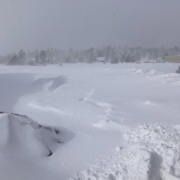
These younger people don’t always know how it used to be. Back then, winters were heavy. Snow would drift so deep you had to dig your way out. The hills were covered, nothing like what we see today.

There wasn’t really a thing called “emergencies” the way people think of it now. We depended on each other, and everything we needed came from the land.

I remember a big storm in the 1960s in Teec Nos Pos. The snow was so high it shut everything down roads, travel, everything. Our sheep corral had a shade structure, and when the snow came down, it covered the whole area. It looked like we lost the entire herd.

But when we went back, we saw something else. The snow had formed around them like an igloo. There was an opening at the top, and what looked like smoke rising but it was steam from the heat of the sheep. They were alive, safe, and warm.

We made it through that storm because we were prepared. We had our supplies. We knew how to take care of ourselves.

About two weeks later, the government showed up with snowmobiles and helicopters, saying they were there to help. But by then, we were already fine.

That’s something I always remember being prepared is what keeps your family safe. You can’t wait for help to come. You have to be ready.

— Larry Johnson, April 23, 2026, Teec Nos Pos, AZ

I Grew Up on My Grandfather’s Land

Dilkon, AZ 

I grew up on my grandfather’s land after my family moved there. It was originally meant to be just a sheep camp, but my parents decided it would be a good place to raise livestock, so that is what we did. We planted our own food and raised animals. We also lived near my mom’s siblings, who were doing the same thing. All of our animals were free to roam and graze on their own. My aunt had many horses, sheep, and other livestock, and she also allowed her animals to roam freely to find water and graze. My mom still has sheep and goats, and currently my brother holds the permit for the livestock. He also has a state permit.

On weekends, we go back to my parents’ home to haul water, clean the corral, and help them with whatever they need. Growing up, my dad was very strict with us. Even though we had running water in the house, he made us take the livestock to the watering hole. He said it was important for us to learn survival skills. My mom, who is the middle child, is the matriarch of our family. Whenever someone has health problems or needs help, everyone goes to her. She keeps track of important information for all her children, including their Social Security numbers.

There is no cell service where we live, which is in a place called Sunflower Butte, southeast of Dilkon. If we need medical help, we have to drive to the hospital, which is about 15 minutes to Dilkon. For more advanced care, we are referred to Winslow, which is about 30 minutes away. From the main road to our house, it is about a five-minute drive, but the road is very rough. We used to maintain it often, but over time people stopped fixing it, so now it is in bad condition.

Because of the poor road, emergency services have difficulty reaching us. In the past, there were discussions about creating a back road to Holbrook to make it easier to access hospitals and essential services, but the project never happened. My aunt did not want to sign off on it because it would affect her grazing area. There was also a proposal to install cell towers to improve emergency communication, but a resident living on top of the mountain opposed it, saying it would be a safety hazard for her grandchildren. As a result, the project was stopped and never reopened. We do not usually prepare in advance for emergencies. Instead, we stay aware and make sure someone is nearby to help elderly family members like my parents. If something happens, we must contact someone close enough to have cell service.

Growing up, we were taught to be self-sufficient. We gathered firewood, tended livestock, and learned how to survive without modern conveniences. Now that we are getting older, it seems the younger generation is less interested in learning this lifestyle. I hope that as they grow older, they realize how important these skills are.

I believe it is important not to forget where you come from and to always put family first. Many people today do not know how to survive without water or electricity, but learning self-sufficiency helps prepare us for natural disasters, especially when living in isolated areas like ours. My grandmother used to tell stories about my grandfather riding his wagon around to help neighbors by bringing firewood, feeding animals, or delivering food. Today, my brother and I try to carry on that tradition. I hope that my younger nieces and nephews will also understand the importance of helping others and keeping those traditions alive as they grow older.

— Ronnie Johnson, April 7, 2026, Dilkon AZ

When the Herd Went Silent

Tsé Daa’ Kaan, NM

Being shaken awake before sunrise, I can still hear my cheii’s voice calling out, “Get up! The sheep are on their way to the grazing fields.” I would jump up half asleep, grabbing a piece of hot ash bread with peanut butter and my gallon jug of water, running out into the dark morning with the sunrise not far behind. I’d meet my siblings and cousins, all of us rushing to catch up with the herd. Back then, our family compound was alive with livestock sheep, horses, and cattle and with that came responsibility, movement, and purpose. I mainly tended the sheep, walking them all day across the land north of Shiprock toward Chimney Rock, where our summer sheep camp stood. That camp was more than a place it was built on family, love, teamwork, and duty. We climbed mesas, laughed, talked, and worked together. Life felt whole. The land felt alive. It seemed like everything the grass, the plants, even the birds and bees moved in rhythm with us.

Then everything changed. When my cheii passed on, something deeper than routine was lost. The corral at home emptied. The movement between summer and winter camps stopped. The care, the discipline, and the heart that held everything together disappeared. Without that leadership and connection, the livestock slowly faded, and with them, that sense of unity. They say when the one who gives their heart and soul to the animals is gone, the animals know and they follow. What was once a lively, connected way of life became quiet. The dream of that life still comes back to me sometimes, like a memory trying to wake me up again. It reminds me of a time when we lived fully in the present, when family came together through shared responsibility, and when we truly saw and heard one another.

— Sarah Tsosie, Tsé Daa’ Kaan, May 2026