Carrying the Teachings Forward
Rough Rock Chapter
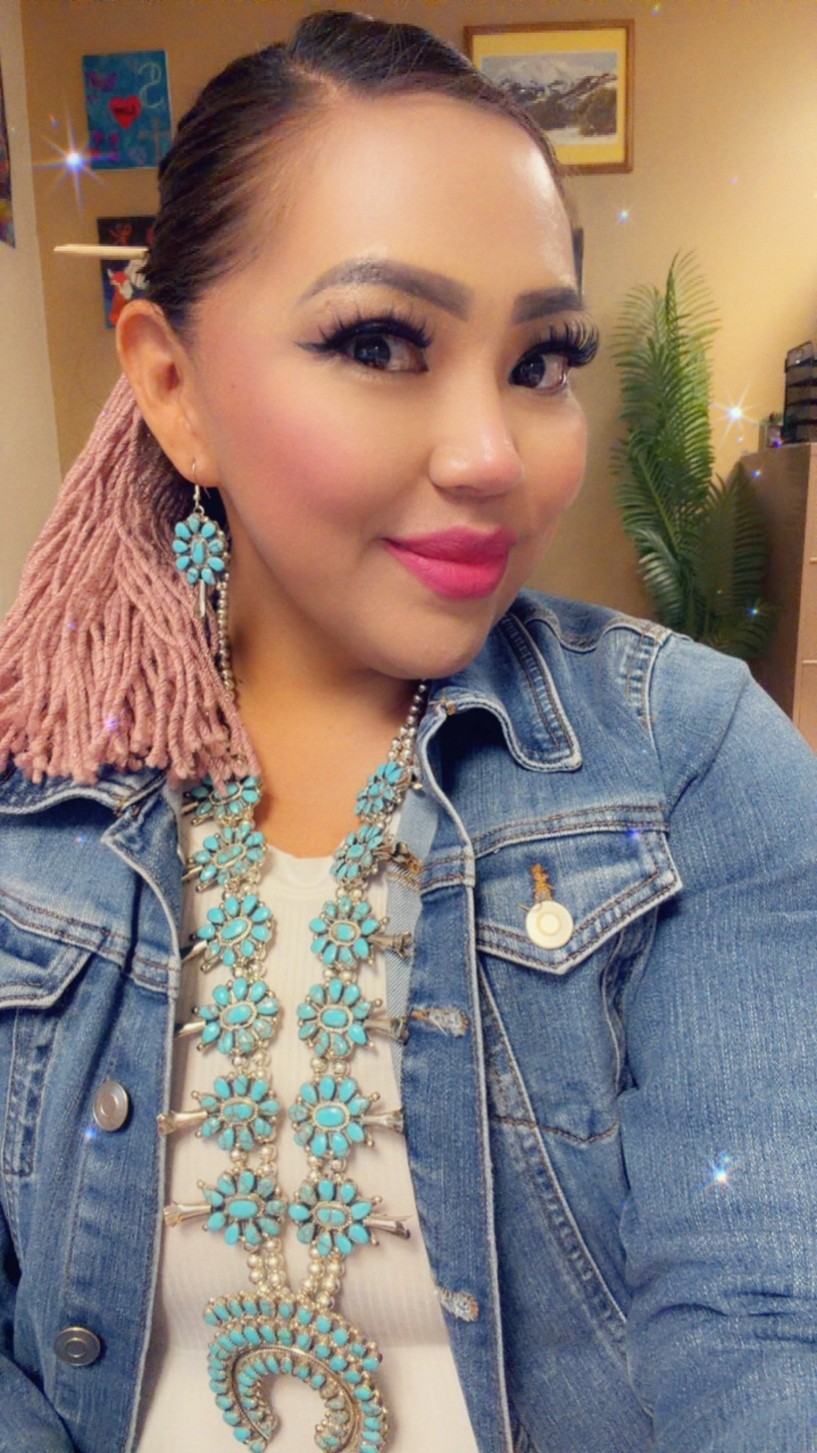
Shí éí Emmalena Hott yinishyé, Oosei Ashihii nishłį́, To’aheedlini bashishchiin, Tsi’naajinii dashicheii, Hashk’aan Hadzohi dashinalí, Tsiizizii déé’ naashá.
I am a Navajo woman, mother, and Navajo teacher. Today, I have the opportunity to teach our language and culture to young people, but becoming a Navajo teacher was never something I planned. Looking back, I realize that so much of what I do today comes from the people who raised me and the teachings they gave me when I was young.
When I was about eight years old, my mom moved to Rock Point, AZ, and I went to live with my nálí man and nálí lady. I was very close to my nálí man, Woodrow Hot Sr., who was a well-known Navajo medicine man, and my nálí lady, Emily Hot, was always by his side.
Because my nálí man was often away during the week performing ceremonies, my nálí lady wanted me to learn how to drive so I could take her to follow him. I was only eight years old when she started teaching me to drive. I would drive her around so we could find my nálí man wherever he was conducting ceremonies, songs, or dances.
I remember one time she told me, “Come with me. Let’s go.” So I went with her, and we traveled toward Goulding, Utah, to find my nálí man. That was the first time I really saw him perform a ceremony. I watched him and listened to the songs and prayers. At such a young age, I didn’t fully understand everything I was seeing, but I knew there was something special about it. I kept listening. I kept watching. As I grew older, I continued going with them.
Those experiences became some of the most important parts of my childhood.
Growing up in Leupp, I didn’t understand much Navajo because my grandparents did not speak Navajo. They only spoke English. But when I moved to Rough Rock, everything around me changed. My aunties spoke Navajo, and they taught me so many things. They taught me how to cook, make bread, clean, and take care of things at home. I was learning things that were not written down in a book. I was learning by watching and being with them.
I spent my junior high and high school years following my nálí man and nálí lady to ceremonies, songs and dances, and gatherings. I learned about the songs, medicines, and plants that were used. I would go with them into the mountains to gather plants, and nálí lady would tell me what the different leaves and plants were.
I also grew up surrounded by elders. Sometimes I would be the youngest person there, surrounded by my grandmothers and other elders. At the time, I probably didn’t realize how special that was. Now, when I look back, I understand that they were giving me something that I would carry for the rest of my life.
My nálí lady taught me the old ways of caring for people. She taught me about weaving and many other things that became part of who I am. We grew up poor, but we had something that meant more than material things. We had love, family, and prayer.
My nálí man always reminded us that prayer was something we would always have. That teaching stayed with me. No matter what happened in life, I knew I could always pray.
As I got older, I had children. I decided to go to college because I wanted to become a nurse. I studied nursing at Navajo Technical College, but after finishing my degree, I had to wait because there was no instructor available for my RN program.
I didn’t know it at the time, but that disappointment was going to lead me somewhere else.
I decided to continue my education in Early Childhood Education and earned my Bachelor of Arts degree. I graduated and still felt like I wasn’t finished with school. I never really planned on becoming a teacher, but somehow life kept leading me in that direction.
The master’s program in Diné Leadership at NTU caught my attention because the classes were all taught in Navajo. I thought, “Oh, that sounds interesting.” So I decided to continue my education and started taking the classes.
After I graduated, I wanted to come back home to Rough Rock and find work. When we returned, the community knew that I had taken my master’s classes in Diné Leadership and had continued learning through Navajo-language courses. They asked me if I would become a Navajo teacher.
But before I could teach, I had to take my Navajo teaching license test. The entire test was in Navajo. I remember sitting in Window Rock with about ten people. Most of them were older women, and I was the youngest one sitting there. I hadn’t really studied for the test, but I went in and took it.
Out of those ten people, I was one of the ones who passed.
I was so proud of myself because I realized that everything I had learned growing up had prepared me for that moment. The language I heard from my aunties, the songs I listened to, the teachings I received from my grandparents, and everything I experienced as a child had stayed with me.
I became a licensed Navajo teacher.
I taught in Rough Rock for a year before moving to Dulce, New Mexico. I taught pre-kindergarten for three years and first grade for two years. While I was there, I had the opportunity to learn about Jicarilla Apache culture and ceremonies. Many of my students came from different tribal communities, including Jicarilla Apache and Pueblo communities. I was invited to learn about their traditions, and I loved it.
I spent about five years there, and those experiences taught me to appreciate not only my own culture but the cultures of other Native communities as well.
Eventually, a Navajo teaching position opened in Rough Rock, and I knew I wanted to come home.
By that time, something else had happened in my life that changed me deeply.
My nálí lady passed away in 2023.
I took it very hard because she wasn’t just my grandmother. She was like my mother. She was one of the people who raised me, taught me, and showed me how to live. So when she was gone, I felt like I had lost a part of myself.
But as I grieved, I started thinking about everything she had given me.
I thought about being eight years old and learning how to drive because she wanted me to take her to follow my nálí man. I thought about all those trips to ceremonies, songs, and dances. I thought about sitting with her, listening to her speak Navajo, learning about plants, learning how to care for people, and watching my nálí man perform ceremonies.
I thought about all those days I spent surrounded by elders.
Then I realized something.
I still had those teachings.
They were inside me.
That’s when I decided I wanted to be a Navajo teacher. I wanted to take everything my nálí had taught me and pass it on. I wanted my children and my students to have the opportunity to learn the things that I was fortunate enough to learn growing up.
I never thought I would become a Navajo teacher, but now I truly enjoy it. I feel like I am carrying something forward for the people who came before me.
Today, I tell my students that our identity is who we are. I tell them that knowing your clans is important because your clans tell you who you are and where you come from as a Diné person.
Even if you only know two of your clans, that is a beginning.
I also tell them not to be afraid to speak Navajo.
Some of our children understand Navajo but have a hard time speaking it. I tell them that it is okay. What matters is that they try. Keep practicing. Keep saying the words. Don’t be afraid of making a mistake.
I wish people would encourage children when they try to speak Navajo instead of laughing at them or making them feel like they are saying it wrong. When a child is laughed at, they may stop trying altogether.
I tell my students, “If you don’t know, I’ll ask. We’ll learn together.”
That’s how I want my classroom to be.
I also believe children learn best when they can be hands-on. Instead of just standing in front of them and lecturing or showing them slides, I want them to experience the language and culture. When they are doing something, they become interested. They begin to understand why it matters.
Our language and culture are changing, and we are losing many of our elders and medicine people. There are fewer people from the younger generations who are learning the songs, ceremonies, medicines, and teachings. Once those elders are gone, we cannot simply replace what they knew.
That is what worries me.
We have to teach our children while we still have people who can teach them.
For children who are being raised by their grandparents, I always tell them to cherish every moment. Listen to your grandparents. Hold on to their teachings. Remember the things they tell you.
Because one day, they won’t be there to ask.
When that happens, the teachings they gave you may be the only thing you have left.
That is why I believe we have a responsibility to carry those teachings forward. What our elders gave us should not stop with us. We have to teach our children and give them the same opportunity to know who they are.
I may not have planned on becoming a Navajo teacher, but now I understand why I was led here.
Everything I learned as a child, everything my aunties and grandparents taught me, prepared me for this.
I am teaching because I want their teachings to continue.
I want my students to know who they are, where they come from, and why their language matters.
Most of all, I want them to know that being Diné is something to be proud of.
Our language is part of who we are. Our teachings are part of who we are. And as long as we continue to teach, learn, practice, and share what our elders gave us, those teachings can continue to live through the next generation.
– Emmalena Hott, Rough Rock Chapter, September 2026