Drawing My Own Court: Bringing Basketball Back Home
Shiprock Chapter
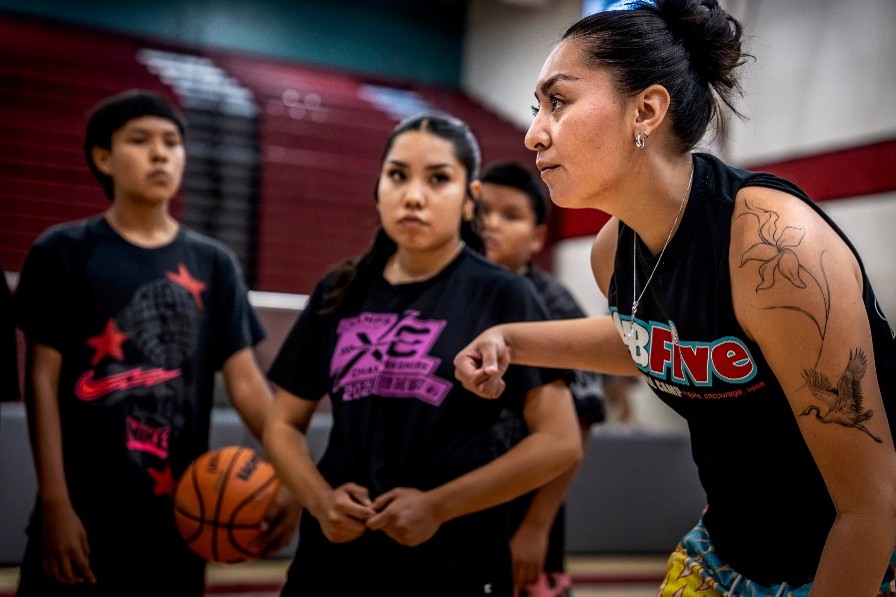
My name is Analyss Benally. I was born and raised in Shiprock, New Mexico, on the Navajo Nation. I am currently an overseas professional basketball player, and I have played professionally for the last five years after playing Division, I basketball at San José State University in San Jose, California. During my off-season, I return home and run my ABFivee basketball camps for Native youth.
I lived in Shiprock until I was about nine years old. I grew up close to my parents and grandmother before my family moved to Farmington. When I was 12, we moved to Kansas because my oldest sister was playing college basketball there. Eventually, I followed that path and played Division I basketball at San José State.
Basketball has been part of my life for as long as I can remember. My dad and my sister were the ones who really got me into the sport. My dad was always playing in weekend tournaments, and I grew up watching him play. I also watched my sister play, so I was always around basketball and in the gym. My mom was our balance. She wasn’t a sports person, but she made sure we stayed focused on schoolwork and everything we needed to do at home. My parents gave my sister and me a good balance between sports, school, and home.
Moving from Shiprock to Farmington and then to Kansas also showed me how different opportunities could be. Moving to Kansas was a cultural shock for me because of the diversity and the different environment I was suddenly in. I also noticed a difference in the level of basketball. I was fortunate to attend a high school with a strong basketball program. When I was an incoming freshman, there were about five or six girls who went on to play Division I or Division II basketball, including two of the top girls in the country. I was able to practice and train with them every day, and that helped me quickly see another level of the game.
After my first year playing professionally in Romania, I started ABFivee camps. At first, the camps were small and local, with programs in Farmington, Shiprock, and Bloomfield. As the summers continued, the camps grew, and we began traveling to different rural areas and reservations. We have been able to partner with different organizations and clinics, including Bounce, a nonprofit charity based in Australia that empowers Native youth there through basketball camps.
For me, the camps are about much more than basketball. I want the kids to be active, but I also want them to learn how to work together, communicate, and use their voices. One of the first things I noticed at the camps was the social aspect. Some of the kids don’t know each other when they arrive, and I can see them become more comfortable as they interact and work together.
We encourage the kids to ask questions and speak up. I always tell them to use their voice because eventually, they are going to have to. Basketball gives them a place to practice those skills, but those lessons can carry into everyday life.
One memory from my childhood that has stayed with me is something my dad always tells when he talks about me at camp. When we lived in Shiprock, we had a basketball hoop outside, but the goal had fallen over and the backboard had cracked. There were certain spots where I couldn’t shoot. My dad would tell me to come inside, but I wanted to practice.
The ground outside was mostly dirt and I kept a shovel next to the hoop. I wanted to make the space feel like a real basketball court, so I would take the shovel and draw out the lines of a court. I learned how to measure the lines using my feet so I could make them as accurate as possible.
My dad says that every night the wind would blow across the dirt and erase the lines I had drawn. The next day, I would go back outside, grab the shovel, and draw the court all over again.
When I was younger, I didn’t think much about it. I was just doing what I wanted to do. But as I’ve gotten older, I understand what my dad saw in that. I wanted to be outside. I wanted to practice. I wanted to create the court I needed, even when I didn’t have a perfect one.
That memory reminds me of why I continue coming home and working with Native youth. I know that every child comes from a different home and has different experiences. I was fortunate to grow up in a household where I didn’t personally experience some of the challenges that many young people face. Because of that, I don’t want to pretend that I know what it’s like to experience something I’ve never experienced. What I can do is share what I have learned and encourage young people to use their voices.
I believe learning how to speak up is important. If a child can learn to use their voice in a setting like a basketball court, I hope they can carry that confidence with them when they are going through something more serious and need help. Speaking up is never a bad thing, and asking for help can only help you move forward.
I also want young people to understand that success doesn’t mean you have to leave home and never come back. Home can be a learning resource. The things we learn away from home can also be brought back and shared with the next generation.
As we get older, I believe it becomes our responsibility to bring what we’ve earned back to the reservation and show younger generations what is possible. Some people might always say you could be doing more, but I believe coming home and continuing that cycle of teaching is important.
My goal for ABFivee is to continue growing the camps and eventually take them internationally. I would love to work with First Nations communities in Canada, travel to Australia and New Zealand, and partner with Indigenous communities in different parts of the world. I want to learn about different cultures and see how we can connect through sports and youth programs.
I also want to expand the camps beyond basketball. I would like to bring in different specialists and create more of a workshop-style program where kids can rotate through different activities. They could learn Navajo, spend time on the basketball court, learn another skill, and then come back to the court. I want to build something that gives kids different opportunities to learn and grow.
No matter how far basketball takes me, I want to continue coming home. I want the kids to see that there are opportunities beyond what they may see around them, but I also want them to know that they can take what they learn and bring it back home.
For me, it all comes back to using your voice, believing in yourself, and coming home whenever you can.
Analyss Benally, Shiprock Chapter October 2026